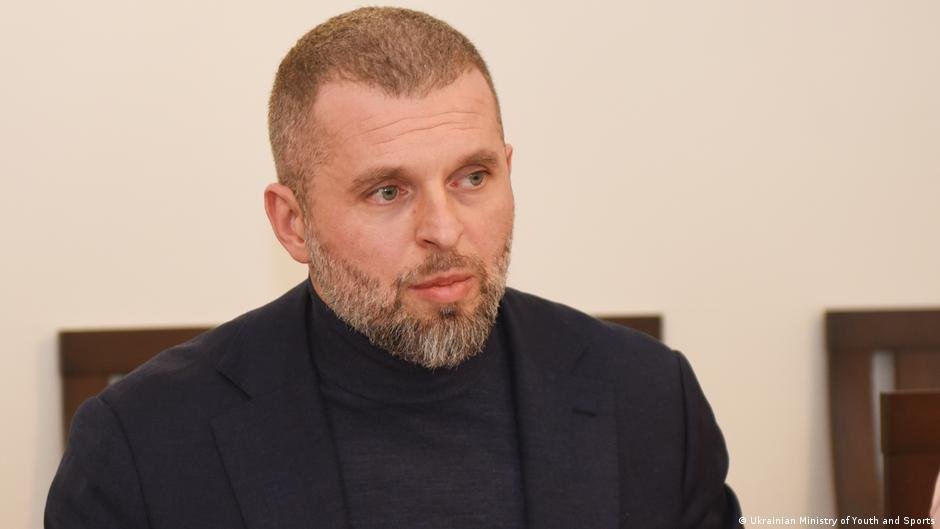
Ukrainian Sports Minister Matviy Bidnyi says he is “outraged” at the International Olympic Committee’s (IOC) decision to lift restrictions on Russian athletes and he has called on IOC President Kirsty Coventry to visit Ukraine.
“Together with all Ukrainians and the entire clean sports community worldwide, I am profoundly outraged. This decision is deeply unfair to every athlete who plays by the rules, and it is a total disrespect to the memory of hundreds of Ukrainian athletes killed by Russia,” Bidnyi wrote in response to a DW query.
Bidnyi added that Coventry should come to Ukraine in order to “see the reality with her own eyes.”
“I want her to stand on our train platforms and see our defenders saying goodbye to their children before leaving for the frontline. I want her to visit our ruined sports academies and meet our young athletes who have to train under missile sirens. I am absolutely convinced that after witnessing this firsthand, any talk of ‘neutrality’ or ‘procedural compliance’ would stop immediately,” the sports minister said.
To view this video please enable JavaScript, and consider upgrading to a web browser that supports HTML5 video
A legal trick?
In its statement released on Tuesday, the IOC said that analysis conducted by its Legal Affairs Commission had found that the Russian Olympic Committee (ROC) no longer included any regional sports organizations in territories falling under the jurisdiction of the Ukrainian Olympic Committee.
Russian Sports Minister Mikhail Degtyarev welcomed the IOC’s decision, saying it should clear the way for Russian athletes to make a full return to international sport.
However, Bidnyi, his Ukrainian counterpart, said this was misleading because the ROC had actually excluded all 89 of its regional sports organizations, not just those in conquered Ukrainian territory.
“A direct exclusion of only Ukrainian territories would be perceived inside Russia as a sign of weakness. It would be a de facto admission that these territories do not belong to them – which is the absolute truth. I simply do not believe that the IOC fails to understand this. This is a deliberate decision to ignore reality, which completely ruins their own credibility.”
DW has approached the IOC for comment on the matter.
Russia has been shut out of international sporting competitions since it launched its full-scale invasion of Ukraine in 2022, with the IOC suspending Russia’s Olympic Committee in 2023. In both Paris in 2024 and in Milano Cortina in 2026, some Russian athletes were still able to compete as neutrals but only if they could prove they did not support the war and had no affiliation with Russia’s military or security forces.
In 2023, Bidnyi said in an interview with DW that calling Russian athletes “neutral means supporting murder.” Three years later, Ukraine’s sports minister met the latest IOC decision with an equally powerful response.
“It sends a dangerous message of total impunity to the entire world,” Bidnyi wrote.
Near-daily attacks continue
Recently, Ukrainian drone attacks have sparked fires at an oil refinery, fuel depots and a port in southern Russia. Kyiv described the strikes as retaliation for Russia’s near-daily attacks on Ukrainian civilians and energy infrastructure since Moscow launched its invasion.
“For Ukraine, this is a matter of survival. Since the full-scale invasion began, 688 Ukrainian athletes and coaches have been killed by Russia. Additionally, 911 sports infrastructure facilities have been ruined or damaged,” Bidnyi said.
Vladyslav Heraskevych had his Olympic moment “stolen” as a result of honoring some of these athletes at the 2026 Winter Olympics. The Ukrainian athlete was prevented from competing in the men’s skeleton for wearing a helmet showing the portraits of more than 20 Ukrainian athletes who have been killed since Russia launched its invasion.
Fighting to stop ‘moral failure for the entire sports world’
Ukraine’s sports minister said the country will fight the IOC decision in order to “defend the true values of sport.
“The symbols of an aggressor state have no place at international sports events,” Bidnyi said. “We cannot allow the world to forget the cost of this war, and we will keep exposing how Russia uses sport as a tool for war propaganda.”
When asked whether he agreed with Coventry’s position, that punishing athletes for the actions of governments is unfair, Bidnyi disagreed. The sports minister said this was not about individuals being punished for their passport, but more a case of accountability.
“You cannot celebrate ‘human dignity’ on an Olympic podium while your institution turns a blind eye to the ongoing murder of Ukrainian athletes,” he said.
In Tuesday’s statement, the IOC confirmed that the previous requirement that neutral athletes demonstrate that they have no links to Russia’s military and security agencies and hadn’t publicly supported the war, had been dropped,.
Coventry said though, that the IOC would continue to monitor social media posts by Russian athletes.
“That is strong enough leverage that we would need at any time in order to decide who would be willing and deserving to come to any Olympic Games,” she said.
The ban on the playing of the Russian national anthem and the flag being displayed also remains in place – for now. Bidnyi believes that if Russia’s flag does fly at the Olympic Games in 2028 in Los Angeles, it will amount to “a moral failure for the entire sports world.”
Jonathan Crane contributed to this report.
Edited by: Chuck Penfold
About The Author