US Army detonates toxic explosives in Iowa despite contamination fears
Acting Secretary of the Army Adam Telle said the operation was “a huge success.”
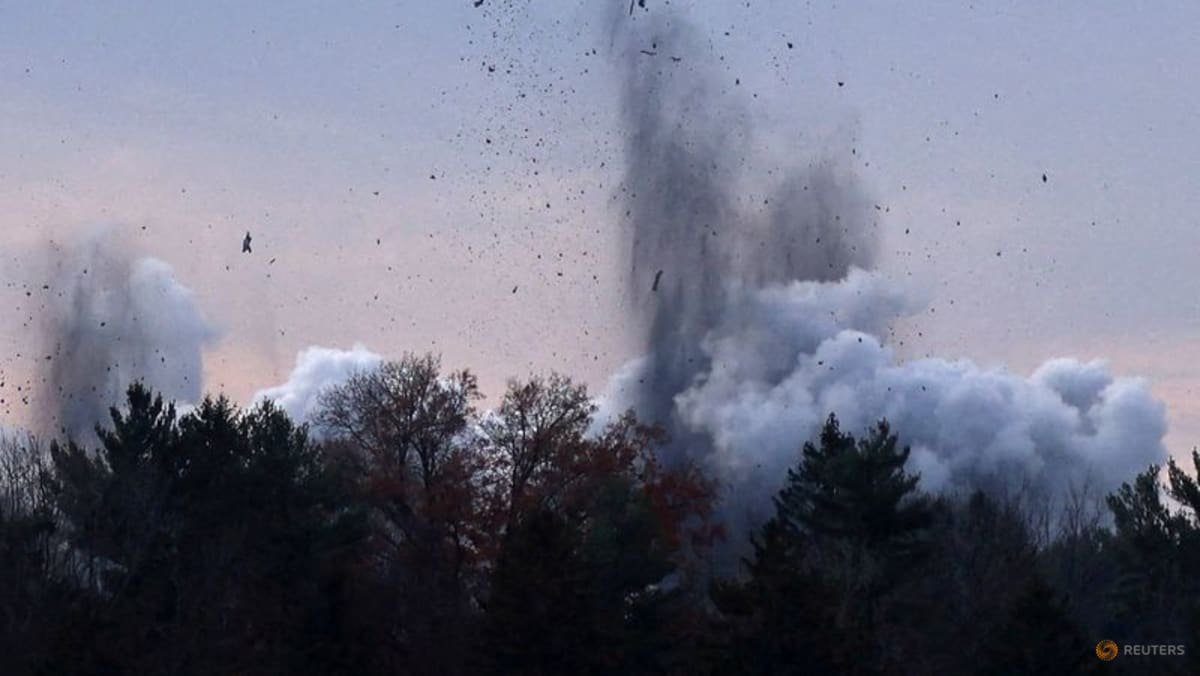
The US Army detonates a degraded stockpile of lead azide at the Iowa Army Ammunition Plant in Middletown, Iowa, US, Nov 25, 2026. (Photo: REUTERS/Jim Urquhart)
Read a summary of this article on FAST.
Get bite-sized news via a new
cards interface. Give it a try.
Click here to return to FAST
Tap here to return to FAST
FAST
WASHINGTON: The US Army detonated a massive cache of toxic explosives stored in a tiny Iowa farming town Wednesday (Nov 25), saying the materials were too unstable to move to a safer area and warning residents to shelter from the blast and a potential cloud of lead dust.
Officials said the 68 drums of lead azide – the entire US stockpile of the degraded material – were at risk of spontaneous explosion, requiring their destruction at the Iowa Army Ammunition Plant in Middletown, where they had been stored for more than 15 years.
Measures were put in place to curb potential contamination from the destruction of the nearly five tons of explosive material, but the Army encouraged residents of Middletown, Iowa and other nearby areas to leave prior to the blast “out of an abundance of caution.”
The controlled explosion sent debris flying into the air and a large cloud of smoke over a tree line, while a New York Times reporter said the blast could be heard some 10 miles (15 kilometres) away. US President Donald Trump said in a post on his Truth Social platform that “early reports from Iowa are that the Army’s mitigation efforts have far exceeded expectations.”

Acting Secretary of the Army Adam Telle said in a post on X that the operation was “a HUGE success.”
“We are watching EPA’s MASSIVE sensor array throughout the area closely, and there are no readings so far above 0.0,” Telle said, referring to the Environmental Protection Agency.
EPA chief Lee Zeldin said on CNN that sampling showed there was “no detection” of lead for now.
The detonation of the explosives was initially scheduled for Nov 20 but was postponed for three days, after which Trump paused the operation pending a court decision and approval from the state’s incoming governor, Rob Sand.
“EXTENSIVE PROTECTIVE WORKS”
The court cleared the way for the detonation in a ruling on Monday evening, while Sand said the same day that the “administration should make this decision based on the information they have from the people they brought in to do the job months ago.”
Colonel Aaron Teller, who led the explosives experts who carried out the detonation, said the last major disposal of lead azide occurred in 1977, when some 7,000 pounds of the substance were destroyed in an open-air blast in Colorado.
Teller said in that case, 75 per cent of the lead particulate remained at the site even with no mitigation measures, and that steps were taken to better contain it in the Iowa detonation.
“There’s extensive protective works around those two bunkers, earthen-filled barriers that extend well above the tops of those magazines,” Teller told journalists ahead of the detonation.
There was also a vent in the protective works designed to send material released by the blast into an uninhabited area on the grounds of the ammunition plant.
Large water tanks were installed at the site to contain the explosion and keep lead particulate from entering the atmosphere, Teller said, while the Army also sought to curb the blast and the material it released by flooding the exterior of the magazines with a foam material.

The Army released two maps on Wednesday, one showing potential exposure to toxic lead dust in the air in an area extending more than 75 miles (120 kilometres) southwest of the blast site, and another picturing possible exposure on surfaces in a more limited area.
“Consider avoiding the highlighted area or remain indoors with windows/doors closed,” the maps said, warning that “children under six are especially vulnerable to lead exposure.”
The Army also urged a local evacuation prior to the detonation, saying the Federal Emergency Management Agency was “supporting the recommended relocation for all residents of Middletown, Iowa, and immediate surrounding impacted areas.”
“Evacuated individuals will be notified by phone once the all-clear is given and at that point may return home,” the Army said.
Source: AFP/fs
Sign up for our newsletters

Get the CNA app
Stay updated with notifications for breaking news and our best stories
Get WhatsApp alerts
Join our channel for the top reads for the day on your preferred chat app

Get bite-sized news via a new
cards interface. Give it a try.
Click here to return to FAST
Tap here to return to FAST
FAST