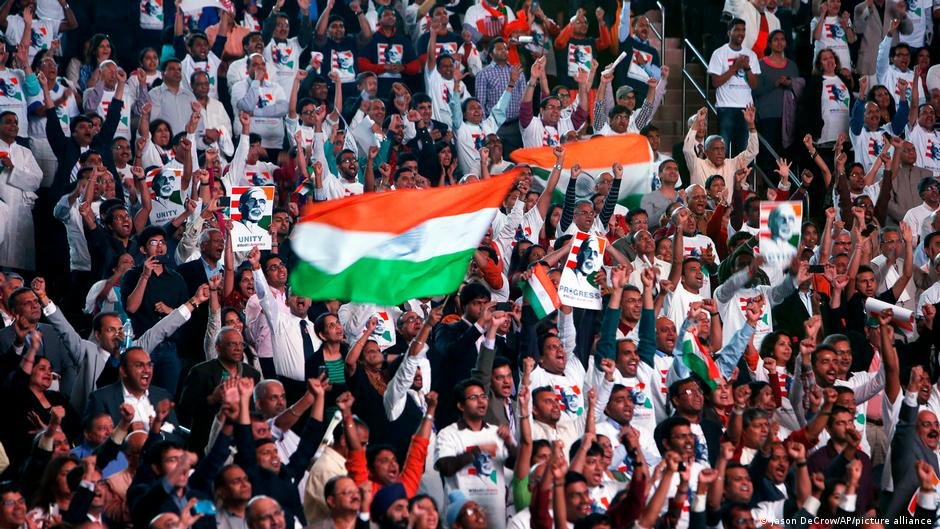
The US Supreme Court’s recent decision to leave birthright citizenship intact offers relief to thousands of Indian families, even as the political battle over who deserves to be American is far from over.
When the top court’s ruling came through on June 30, Rajesh and Neha, an Indian couple living in Seattle, read the news over breakfast before leaving for work.
Rajesh, a software engineer, moved to the US from the southern Indian city of Bengaluru in 2016 on an H-1B visa. Neha joined him a year later. Their six-year-old daughter, Aanya, was born in the United States.
“It was a relief,” Neha told DW. “For months, we kept wondering if something so fundamental could really change.”
Their daughter remains an American citizen. But for her parents, little else has changed. Like thousands of Indian professionals in the US, they are still waiting for employment-based green cards after years in the queue.
“We’re happy our daughter’s future is protected,” said Rajesh. “But we’re still living one visa renewal at a time.”
To view this video please enable JavaScript, and consider upgrading to a web browser that supports HTML5 video
A sigh of relief
The US Supreme Court at the end of June left birthright citizenship intact, ruling that children born on US soil remain citizens regardless of their parents’ immigration status.
US President Donald Trump signed an executive order last year decreeing that children born to parents in the United States illegally or on temporary visas would not automatically become US citizens.
That order now remains blocked and under legal challenge.
“The ruling is a profound affirmation of who belongs in America,” said Chintan Patel, executive director of Indian American Impact, a civic and political advocacy organization.
“Indian and South Asian immigrant families are among those most directly threatened by Trump’s executive order, communities navigating long visa backlogs and uncertain immigration timelines, where children are often born here long before their parents have a clear path to permanence,” said Patel in a statement.
Indians are the second-largest Asian-origin group in the US after Chinese Americans, according to a May 2025 Pew Research Center fact sheet.
About 5.2 million people of Indian origin lived in the US in 2023, roughly 21% of the country’s population of Asian origin.
Indians are the largest recipients of H-1B visas, the program that lets US companies hire skilled foreign workers. They also face the longest waits for employment-based green cards, because of per country caps.
Community organizations estimate that hundreds of thousands of children have been born in the US to Indian parents on temporary work visas.
The court ruling now preserves their citizenship, along with the rights that come with it, including US passports and social security numbers.
To view this video please enable JavaScript, and consider upgrading to a web browser that supports HTML5 video
Life in immigration limbo
For many Indian professionals, the ruling addresses only one part of a much larger problem.
Employment-based green cards are subject to annual country quotas, creating an enormous backlog for Indian applicants. Various estimates suggest well over a million Indians are waiting for permanent residency, some for decades.
Workers hesitate to change employers, afraid of disrupting their status. Spouses can face restrictions on employment.
Children who came in as dependents can lose their legal status when they turn 21, if their parents have not yet secured permanent residency, a problem known as aging out.
Against that backdrop, birthright citizenship has remained one of the few certainties families could count on.
“The ruling reinforces the longstanding constitutional principle that anyone born in the US is a citizen, irrespective of their parents’ immigration status,” Rajkrishna S Iyer, a US immigration attorney specializing in employment and family-based immigration, told DW.
“For Indian H-1B families, it means their children continue to acquire US citizenship at birth.”
The political fault line
The ruling also brings back into focus one of the most divisive questions in American politics.
For years, Trump and many conservatives have argued that automatic birthright citizenship encourages abuse of the immigration system.
The deliberate attempt to use the current system to get US citizenship is one of the concerns for conservatives and immigration opponents.
Supporters of Trump’s position say birthright citizenship creates incentives for what they call “birth tourism,” where foreign nationals travel to the US specifically to give birth so their children acquire American citizenship.
To view this video please enable JavaScript, and consider upgrading to a web browser that supports HTML5 video
Iyer said this objection generally doesn’t apply to H-1B visa holders.
“Notably, the conservative public has voiced comparatively little objection to legal immigrant workers having children in the US,” he pointed out.
According to Iyer, H-1B holders are legal workers who contribute to the tax base and generally aren’t perceived as a drain on public resources.
“Hence, the underlying objection appears less about immigration status in the abstract, and more about circumventing the legal system altogether, entering the country unlawfully, or exploiting a legal visa for a purpose, birth tourism, it wasn’t intended for,” he said.
Immigration lawyers caution that birthright citizenship is often misunderstood.
Children born in the US cannot sponsor their parents for permanent residency until they turn 21, meaning citizenship at birth does not provide an immediate pathway to legal status for families.
They draw a line between rare cases of organized birth tourism and families who have lived and worked legally in the US for years on employer-sponsored visas.
That distinction matters for Indian H-1B families in particular.
Unlike undocumented migrants, most Indian professionals enter the United States legally, pay taxes and maintain legal status while navigating one of the world’s longest employment-based immigration backlogs.
Karan Thukral, a lawyer based in New Delhi, said Indian professionals are being swept into a debate aimed largely at undocumented immigration.
“The ruling removes one major layer of uncertainty for Indian H-1B families,” Thukral told DW.
“It does not change the reality of decades-long green card waits or life on temporary visas. They are lawfully admitted professionals, and concerns about abuse should not come at the expense of the constitutional rights of US-born children,” added Thukral.
To view this video please enable JavaScript, and consider upgrading to a web browser that supports HTML5 video
A reassurance, not a resolution?
The Supreme Court’s decision does not end the legal fight over birthright citizenship.
Instead, it limits the circumstances in which lower courts can block presidential policies nationwide.
Trump’s executive order will keep facing challenges in courts across the country before the constitutional question is finally resolved.
Meera Shankar, a former Indian envoy to the US, sees the ruling as reassurance rather than resolution.
“The ruling is a relief for many Indian families as it puts children born in the US on a firm legal footing as American citizens,” she told DW.
“But the US has become far less welcoming to immigrants under the Trump administration. It may prompt some highly skilled Indians, who once saw the US as the natural destination for their ambitions, to rethink that choice,” said Shankar.
Edited by: Srinivas Mazumdaru
About The Author