Italian media report that a US citizen, either 29 or 30 years of age, was struck by lightning Sunday evening while hiking on Mount Etna on the Italian island of Sicily. He died of cardiac arrest while a helicopter rescue team attempted to resuscitate him.
The man is thought to have been hiking alone, seemingly in a prohibited area on Etna’s eastern slope, which is experiencing extraordinary volcanic activity at the moment.
Etna’s eruption draws in more tourists
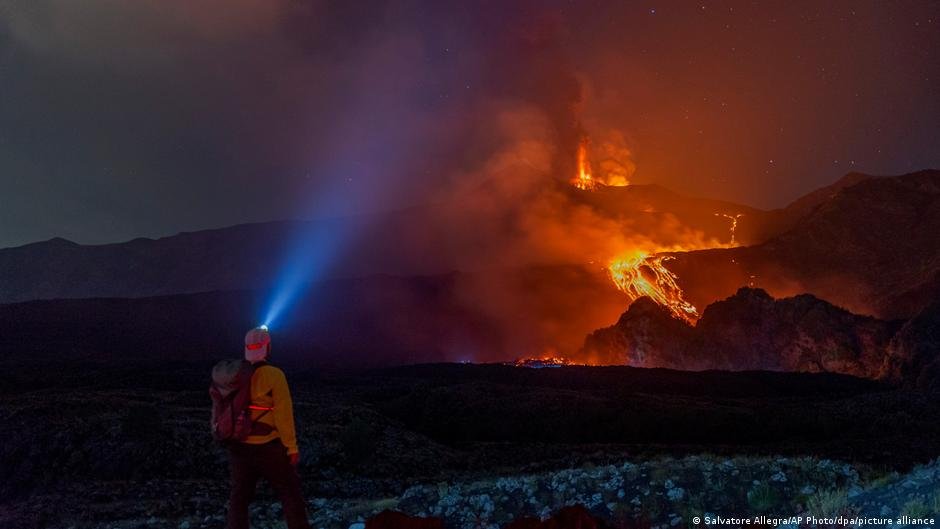
Etna, the tallest active volcano in Europe at 3,324 meters (almost 11,000 feet), attracts throngs of tourists, even more so now, as visitors flock to get pictures of dramatic lava fountains and smoke.
Authorities say the man may have ignored closure markings on Sunday to climb up toward a new crater when he got caught in a storm.
According to emergency services, the US national was in a state of cardiac arrest when a helicopter rescue crew arrived around 8 p.m. local time (18:00 GMT). He is believed to have been struck by lightning as he wandered the barren heights above the tree line.
Rescue workers tried resuscitate the man when they extracted him from the Rocca Capra area of the mountain, some 1,400 meters above sea level. He was pronounced dead on arrival at Cannizzaro Hospital in nearby Catania.
An investigation into the incident is ongoing.
To view this video please enable JavaScript, and consider upgrading to a web browser that supports HTML5 video
Weather patterns add to risks of volcanic activity
Italian authorities have repeatedly warned of the dangers presented by Etna’s activity. However, the natural phenomenon remains also a magnet for photo-hungry tourists and thrill seekers.
In addition to being an active volcano, Etna is also a very large mountain with potentially hazardous areas and specific weather conditions. Italy’s civil protection agency warns volcanic activity and sudden weather changes could create an especially risky combination.
The nearby international airport in Catania has suffered numerous disruptionsas a result of massive smoke plumes that fill the air with gritty, dry micro-particles that make breathing difficult and act like ice on roads.
Edited by: Darko Janjevic
If you rely on our team for trusted reporting, please take a moment to select us as your Preferred Source on Google, so you’ll always see our verified news first.