Skip NavigationMarketsBusinessInvestingTechPolitics & PolicyVideoWatchlistInvesting Club PRO
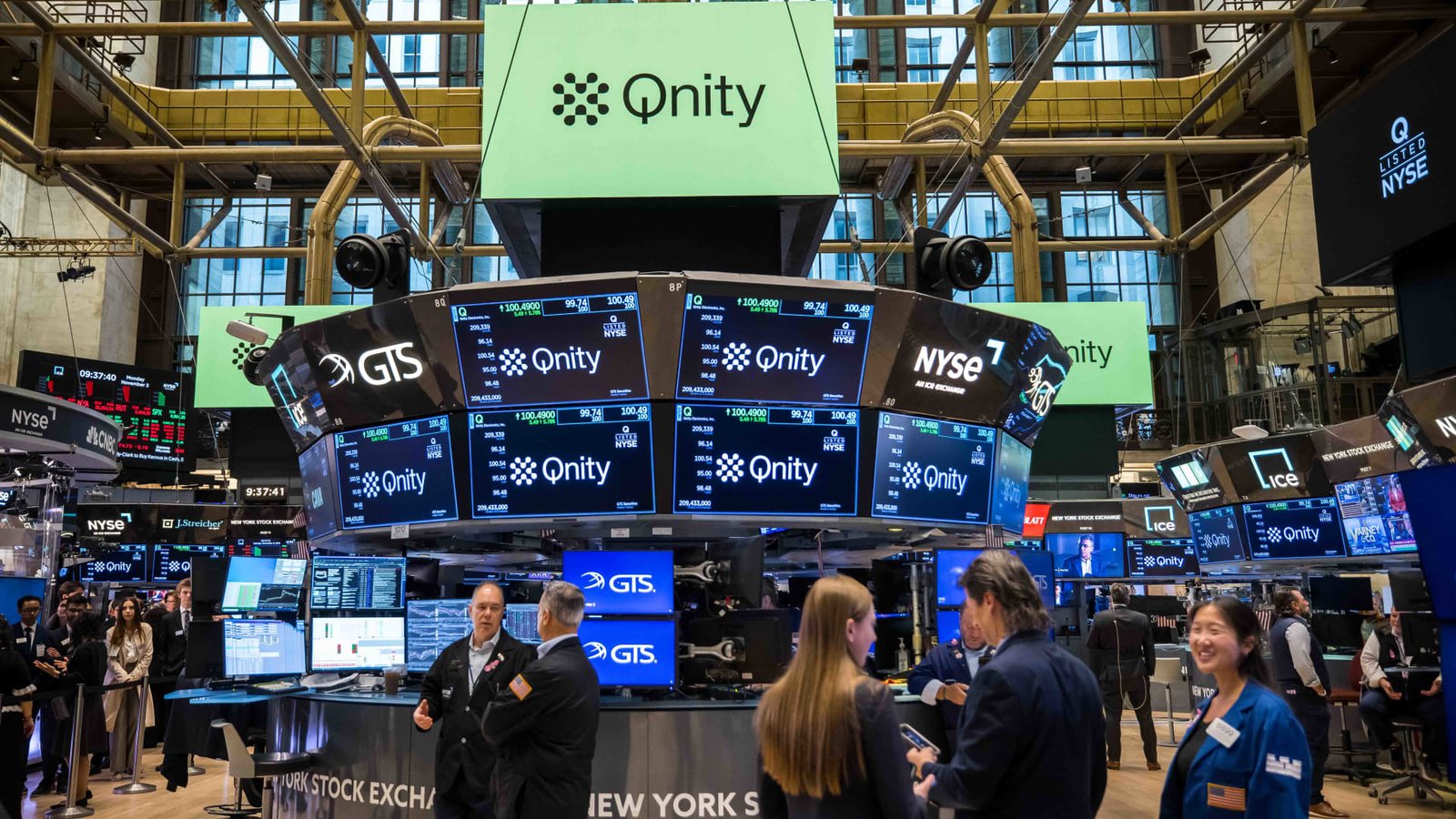
 LivestreamMenuQnity Electronics , a crucial link in the semiconductor supply chain, reported a nice beat-and-raise quarter before Wednesday’s open. The stock fell nearly 6% to session lows mid-morning but erased most of those losses later in the day. Revenue in the third quarter increased 22% from a year ago to $1.56 billion, outpacing the $1.49 billion LSEG-compiled analyst consensus estimate. Adjusted earnings per share (EPS) surged 55% to $1.46, also above the $1.20 expected. Qnity makes many of the specialized chemicals and materials that are essential to chip manufacturing. With chipmakers and chip equipment providers under pressure following the midterm Democratic sweep on Capitol Hill, it was not surprising to see Qnity initially lower. The blue wave is seen as a headwind for the artificial intelligence boom. Q 1Y mountain Qnity Electronics 1-year performance Jim Cramer, however, doesn’t view the election result as a binary event because there is still so much demand for the computing power that semiconductors enable. We saw Qnity as a buy before the quarter, and Jim said on the Club’s Morning Meeting that Qnity’s post-earnings drop makes the stock look even more enticing. Bottom line Qnity delivered its tenth consecutive quarter of profitable growth, a streak dating back to the company’s days under the DuPont umbrella. Qnity was spun off from DuPont a little over one year ago. The stock closed at $97 on its debut on Nov. 3, 2025, and is up more than 20% since then. Along the way, shares soared to all-time highs above $177 in late June before a summer swoon. It’s not uncommon to see big swings in spinoff stocks as they find an investor base. While the quarter was strong, Qnity’s full-year outlook was even stronger. Management raised guidance for sales and earnings that far exceeded expectations. That makes us feel more confident that Qnity won’t be held back much by any election-related data center backlash. Sure, Democrats controlling the House and Senate will make AI infrastructure funding more difficult, which is problematic for money-losing neoclouds that need to build as quickly as possible to generate a return on their borrowed capital. CoreWeave was down another 10%. However, slower data center construction could bode well for the hyperscalers, such as Amazon , which were once free cash flow machines. With market forces driving them to curtail the pace of investment, despite what the CEOs may want, free cash flow has a chance to rebound. That’s why Amazon was up more than 7% on Wednesday. But it’s also why Qnity, which is a “supplier to the suppliers” of AI infrastructure, can trade lower on the back of such a positive release. Nonetheless, we think AI demand in aggregate is still very real and view any weakness in a name like Qnity, which provides the crucial building blocks for the entire semiconductor industry, as exactly what longer-term investors should be looking for. Ultimately, the demand for AI from consumers and enterprise alike is increasing — and with it, demand for Qnity. We recently went to the company’s labs outside Boston for a video tour of how its scientists make and test the products. Given Qnity’s quarterly strength and robust outlook, we’re reiterating our buy-equivalent 1 rating . However, we’re lowering our price target to $165 from $180 to reflect the pressure on semiconductors. Still, our new PT is bullish, implying 38% upside from current levels. Quarterly commentary Qnity’s third quarter was strong across the board. Sales increased 22% on a reported basis and organically. It’s always nice to see strong organic growth because it represents a company’s ability to expand its businesses on its own without the help of mergers or acquisitions. On the earnings call, CEO Jon Kemp noted several important industry trends powering Qnity’s growth, including capacity utilization in DRAM manufacturing in the “high 80% range” and continued improvement in NAND production in the “low- to mid-80s.” That’s an improvement from this time last year. So, memory manufacturing facilities operating at higher rates of their capacity means more demand for Qnity’s products that are integral to the production process. DRAM is short-term memory, and NAND is long-term memory. Both are key to running data centers. There has been a global shortage in memory due to massive AI demand, which has the companies making those chips working flat out. In addition to efficiency improvements, Kemp said his team is monitoring more than 15 advanced manufacturing facilities targeted for the next year. “Once equipment is installed, process qualifications can take 12 to 18 months. From there, materials demand builds as customers ramp toward full capacity.” He sees the AI buildout as a “multiyear opportunity.” Additionally, the CEO said that AI is “broadening beyond data centers into physical artificial intelligence across factory automation, aerospace and defense, and autonomous driving.” The company delivered better-than-expected topline growth in both operating segments, Semiconductor Technologies and Interconnect Solutions . Earnings in the third quarter benefited from strong year-over-year margin expansion in both segments. Qnity’s biggest customers are Samsung Electronics and Taiwan Semiconductor Manufacturing Company . It also works with fellow Club names Nvidia and Apple . Back in March, Qnity partnered with Nvidia to co-develop semiconductor materials and advanced packaging. Later that month, Apple widened its push to expand manufacturing in the United States, adding several new partners, including Qnity. Qnity will produce technology for the new variable aperture in the iPhone 18 Pro camera system. In Semiconductor Technologies , which helps its customers build computer chips and electronic devices, management called out 25% growth in advanced nodes, or precision manufacturing processes, and strong performance from the company’s semiconductor equipment consumables business — primarily Kalrez, which is a specialty sealing material used in products from a variety of industries, from electronics to aerospace to energy. In Interconnect Solutions , which addresses performance challenges, including power efficiency, heat management, signal integrity, and long-term reliability, sales benefited from strength in thermal management, advanced packaging, and AI printed circuit boards, as well as sustained demand from data center, industrial,m and premium consumer electronics end markets. Kemp said, “Thermal management is our fastest-growing platform and has become fundamental to AI performance. For example, as more powerful logic chips and memory modules are tightly packed into AI applications, heat builds quickly and can limit performance and reliability. Our expansive portfolio manages heat at every level, from the chip and memory components to the board and broader system, giving us more opportunities to help customers optimize system efficiency and maximize AI compute.” This aligns with what we heard from Club name Eaton during this week’s earnings call concerning the company’s $9.5 billion acquisition of Boyd Thermal. On Tuesday, Eaton reported a strong quarter and raised full-year guidance. Guidance Qnity used the Q3 strength to raise its full-year outlook. The company expects sales of $5.77 billion to $5.83 billion, a $200 million increase at the midpoint from the previous guide and ahead of the $5.65 billion consensus estimate at the midpoint, according to LSEG. The company expects adjusted operating EBITDA of $1.79 billion to $1.8 billion, a $95 million increase at the midpoint and above the $1.71 billion consensus estimate, according to FactSet. EBITDA stands for earnings before interest, taxes, depreciation, and amortization. The company expects adjusted EPS of $4.95 to $5.05, a 50-cent increase at the midpoint and ahead of the $4.56 consensus estimate, according to LSEG. The company expects adjusted free cash flow of $800 million to $900 million, a $200 million increase at the midpoint and above the $555 million consensus estimate, according to FactSet. (Jim Cramer’s Charitable Trust is long Q, AMZN. See here for a full list of the stocks.) As a subscriber to the CNBC Investing Club with Jim Cramer, you will receive a trade alert before Jim makes a trade. Jim waits 45 minutes after sending a trade alert before buying or selling a stock in his charitable trust’s portfolio. If Jim has talked about a stock on CNBC TV, he waits 72 hours after issuing the trade alert before executing the trade. THE ABOVE INVESTING CLUB INFORMATION IS SUBJECT TO OUR TERMS AND CONDITIONS AND PRIVACY POLICY , TOGETHER WITH OUR DISCLAIMER . NO FIDUCIARY OBLIGATION OR DUTY EXISTS, OR IS CREATED, BY VIRTUE OF YOUR RECEIPT OF ANY INFORMATION PROVIDED IN CONNECTION WITH THE INVESTING CLUB. NO SPECIFIC OUTCOME OR PROFIT IS GUARANTEED.Read More
We’re cutting our Qnity price target but still loved the beat-and-raise quarter
Qnity’s third quarter was strong across the board and so what its full-year guide.

by
Read Time
About the Author

Previous Post
Next Post
Leave a Reply
Latest News






Stay Connected
Categories
BBC News CNA CNBC CNN International Deutsche Welle (DW) Euronews France 24 General Global & European Specialized & Regional
Tags
amp Artificial intelligence Asia Breaking News: Business Breaking News: Markets Breaking News: Politics Breaking News: Technology Business business news cent china cup Donald J. Trump Donald Trump economy European Union fast football France germany india Investment strategy iran Iran war markets People per politics return russia S&P 500 Index said Singapore spain Sport Stock markets technology trump ukraine United States US-Israel attack on Iran 2026 video War in Ukraine World World Cup 2026
About the Author

AF themes
Easy WordPress Websites Builder: Versatile Demos for Blogs, News, eCommerce and More – One-Click Import, No Coding! 1000+ Ready-made Templates for Stunning Newspaper, Magazine, Blog, and Publishing Websites.

Search the Archives
Access over the years of investigative journalism and breaking reports