Morocco recently signed an agreement to participate in the International Stabilization Force (ISF) in Gaza.
This agreement “reflects the shared determination to contribute, through concrete humanitarian and security actions, to the establishment of a climate of peace and security in the region,” Morocco’s state news agency MAP reported in July. According to the report, Morocco’s contribution includes military personnel, police and gendarmerie forces and a field hospital.
Morocco is the first Arab country to join the planned international security mission for the Gaza Strip. Indonesia, Kazakhstan, Kosovo and Albania are also part of the force, while Jordan and Egypt have agreed to supporting roles only.
However, it remains to be seen whether the ISF can ever be deployed on the scale originally envisioned by its initiators.
The force, which is linked to the “Board of Peace” established by US President Donald Trump, is intended to do far more than simply secure humanitarian aid: It’s seen as the security cornerstone of the planned post-war order for Gaza.
No traditional UN peacekeeping mission
The International Stabilization Force is tasked with securing the reconstruction process, protecting humanitarian aid deliveries, and training new Palestinian security forces. In the long term, it is intended to support a political transition.
However, in contrast to traditional United Nations peacekeeping missions, it will be organized outside the usual UN command structures even though the UN authorized the force. This structural difference makes the ISF one of the most ambitious — and one of the most challenging — international projects for the Gaza Strip.
“The involvement of international actors requires at least a minimum level of political stability,” Gil Murciano, executive director of the Israeli Institute for Regional Foreign Policies, told DW. The real problem, he said, is not the mission itself, but the lack of a political framework in which it needs to operate.
Marcus Schneider, head of Germany’s political Friedrich Ebert Foundation’s Regional Project for Peace and Security in the Middle East in Beirut, is also skeptical about the mission’s prospects for success.
“Israel wants to secure military freedom of action, while potential troop-contributing countries are primarily interested in a traditional peacekeeping mission,” he told DW, adding that “these differing expectations pretty much rule each other out.”
This view is echoed by the International Peace Institute (IPI). According to a recent analysis, a stable, legitimate Palestinian administration is needed first; otherwise, the ISF risks becoming yet another international transitional project.
Israel, Hamas, and the Arab states still differ on Gaza’s future
In particular, Israel, Hamas, and the Arab states have differing views on what role the ISF should play. From Israel’s perspective, security is the top priority.
“The Israeli government has made its position very clear: as long as Hamas does not agree to disarm, the reconstruction of Gaza should not begin,” Murciano said. This ties reconstruction to a political condition that has not yet been agreed upon.
In Schneider’s assessment, the actors involved are pursuing different political goals. While Israel wants to preserve its military freedom of action, many potential troop-contributing countries expect a clearly defined mandate with manageable risks. However, these expectations are currently difficult to reconcile.
The stance of Hamas — which is designated as a terrorist organization by the US and the EU, among others — further complicates the planning. Although the organization has signaled a willingness to withdraw from the civilian administration of Gaza, it has so far refused to fully disarm.
From Israel’s perspective, this means that a key prerequisite for the mission’s deployment remains unmet; at the same time, many international actors argue that reconstruction and political stabilization should not wait until all security issues have been resolved.
To view this video please enable JavaScript, and consider upgrading to a web browser that supports HTML5 video
The role of the Arab states in Gaza
Arab states play a key role in Gaza’s future as they are considered the most important financial backers for reconstruction. They could also lend the mission the necessary regional legitimacy. However, many governments want to avoid sending troops and billions in aid to Gaza without a solid political roadmap.
Morocco’s commitment is seen as an important signal, even though it does not change the fact that other major regional powers have so far remained cautious.
The Washington-based think tank Arab Center Washington DC highlights this dilemma. While many Arab states are, in principle, willing to support the reconstruction of Gaza, participation in an international stabilization mission would be possible for them only within the framework of a credible political process, a report stated.
Gaza’s reconstruction as a prerequisite for security
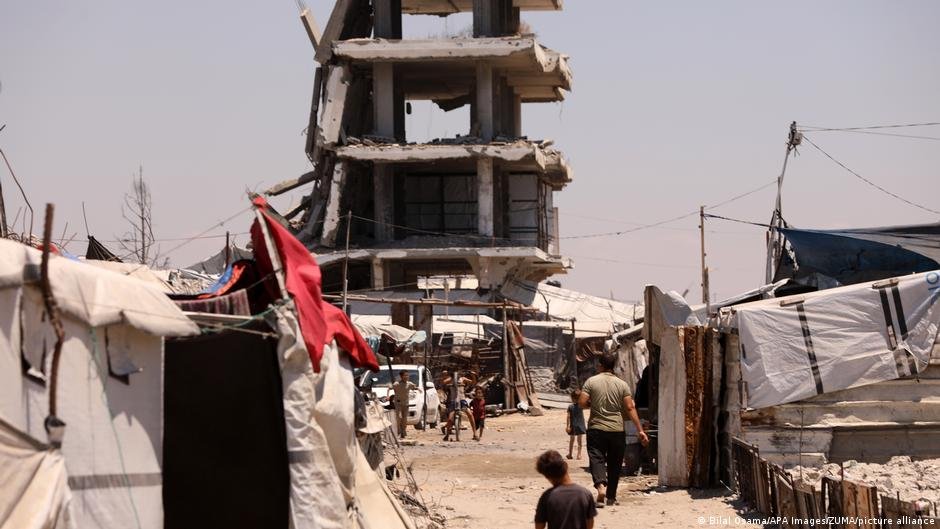
The real challenge lies in solving this stalemate, predicts Murciano. “Reconstruction itself is an essential component of security,” he said. Anyone who separates the two processes risks further entrenching the political stalemate, he added.
Whether the ISF will ever be able to assume its intended role remains uncertain. While planning is well advanced, the mission still lacks the political conditions needed for deployment.
This article was originally published in German.
To view this video please enable JavaScript, and consider upgrading to a web browser that supports HTML5 video