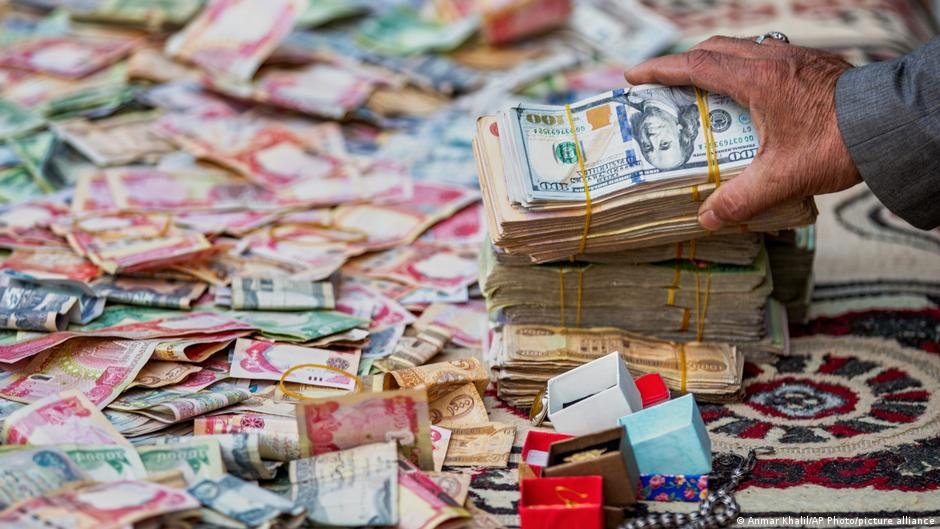
They may be thousands of kilometers away but the Strait of Hormuz — or more specifically, its blockade — is making life increasingly difficult for many ordinary Iraqis.
For the last three months or so, Mahmoud Waleed’s salary has been arriving later and later. The 38-year-old teacher is paid by the Iraqi Ministry of Education, but because Iraq cannot export enough oil through the Strait of Hormuz, the government is running out of cash.
As a result, thousands of Iraqis like Waleed are not being paid on time.
“The delay affects you a lot,” the Mosul local told DW. “Like most people, we have financial obligations as well as basic living expenses. We’re just more and more convinced that we need to reduce expenses and keep some money aside for emergencies — just until things return to normal. It makes you really anxious and fearful.”
“The future looks more uncertain,” adds Ahmed, a doctor from the same city who didn’t want to give DW his full name for personal reasons. “This month, our salaries were delayed by more than 10 days. The Minister of Health explained the state doesn’t have sufficient cash flow and that’s why there was a delay. But we just don’t know how long the next delay will be.”
In early August, there were a number of small demonstrations about the delayed salaries. Staff from universities around the country protested as did employees at the Ministry of Electricity.
Why doesn’t Iraq have cash for salaries?
Almost all of Iraq’s national budget, somewhere between 85% and 90%, comes from the export of its oil.
At the same time, Iraq has a huge and growing public sector, with about two-thirds of the around 30 million working-age Iraqis relying on the state for their livelihoods. That’s why the majority of the state budget now goes towards salaries, pensions and social welfare; every month the Iraqi government needs somewhere between $6.5 billion and $8.2 billion for those payments.
But recently that money has become much harder to find.
Since Israel and the US bombed Iran in late February, Iran has blocked the Strait of Hormuz. Almost all of Iraq’s oil — between 80% to 90% — was shipped out through there because unlike other countries in the region, Iraq doesn’t have significant alternative routes.
As a result of the blockade, Iraqi oil exports decreased by around 83% in March, compared to the same period last year. By May, Iraq’s seaborne crude exports were down 97%.
This means Iraq’s national income has also been severely reduced. Government sources told various local media that Iraq’s monthly income in May and June was somewhere between $2 billion and $2.3 billion, far less than is needed.
It’s that kind of news that recently led to panicked rumors that state salaries would only be paid every 45 days, instead of each month.
Over the past few days, the Iraqi government put out several statements, firstly denying the 45-day rumor and then saying it still had $83 billion in reserves, plus gold holdings and non-oil income. This means salaries can be paid for the next 10 to 11 months, it said on Tuesday.
However that might not be enough. A report by UK advisory firm Oxford Economics this week noted that maritime traffic through the Strait of Hormuz is unlikely to return to normal anytime soon.
“Until at least 2028, traffic levels are expected to fluctuate as tensions ebb and flow, while on average remaining well below pre-conflict norms,” Ben May, director of global macro research said in a statement.
This is a serious crisis, one which “transcends the oil sector,” Iraqi economist Ali Al-Rawi argued in an August report for Baghdad-based think tank the Al Bayan Center. “The entirety of the Iraqi economy is now hostage to… oil revenues.”
Iraq destabilized?
None of the state employees DW spoke to were planning to attend protests if their salaries were delayed again.
And right now, this situation is unlikely to destabilize Iraq, Hayder al-Shakeri, a research fellow at the British think tank Chatham House told DW.
“If salary delays continue, I would expect more protests, but initially they are likely to remain sectoral rather than develop into another nationwide movement like Tishreen,” al-Shakeri said, referring to huge youth-led, anti-government protests between 2019 and 2021. “The government has learned from 2019 and now has a range of political, administrative and security mechanisms to contain protests before they broaden.”
Things could get more dangerous later though if a combination of different problems arise, some of which have sparked larger protests in the past.
“If salary delays are combined with electricity shortages, inflation and deteriorating services over a sustained period, these separate protests could begin to connect,” al-Shakeri predicts. “At that point, Iraq’s recent stability would face a much more serious test.”
What can Iraq do?
Iraq has tried to work around its Strait of Hormuz problem. A small proportion of Iraqi oil is exported via a Turkish pipeline. Oil has also been trucked out of Iraq, then loaded onto ships at Syrian ports. Last week, the Iraqi government announced it was reviving a long-shuttered Iraq-Lebanon pipeline.
Iraqi Prime Minister Ali al-Zaidi also said that when he visited Iran in late July, he asked Iranian officials for special dispensation allowing Iraqi oil to pass through the Strait of Hormuz. The two countries have a good relationship.
Far more important, experts say, is that the new Iraqi government finally implement realistic reforms, measures that reduce corruption and encourage the private sector, moving the country away from oil dependency and offering locals jobs outside of the civil service.
But reforms also require funding — and the latest statistics indicate that this is not what is happening, researchers at economic consultancy Iraqi Horizons wrote this month.
In May, total government expenditure fell by around a quarter compared to last year. Of that, money for salaries, pensions and social security accounted for 99% of all operational spending. Which means there’s very little cash left for anything else, the consultants pointed out.
“Fiscal crises have pushed Iraqi governments towards reform before,” al-Shakeri from Chatham House suggested. “When oil revenues fall, governments become more willing to discuss combatting corruption, increasing non-oil revenues and supporting the private sector. But once oil money begins flowing again, the political incentives for reform weaken.”
The current crisis could create an opening for reform in Iraq, al-Shakeri concluded. “But whether those openings survive once the immediate pressure eases is the real question.”
To view this video please enable JavaScript, and consider upgrading to a web browser that supports HTML5 video
Edited by: Carla Bleiker
About The Author