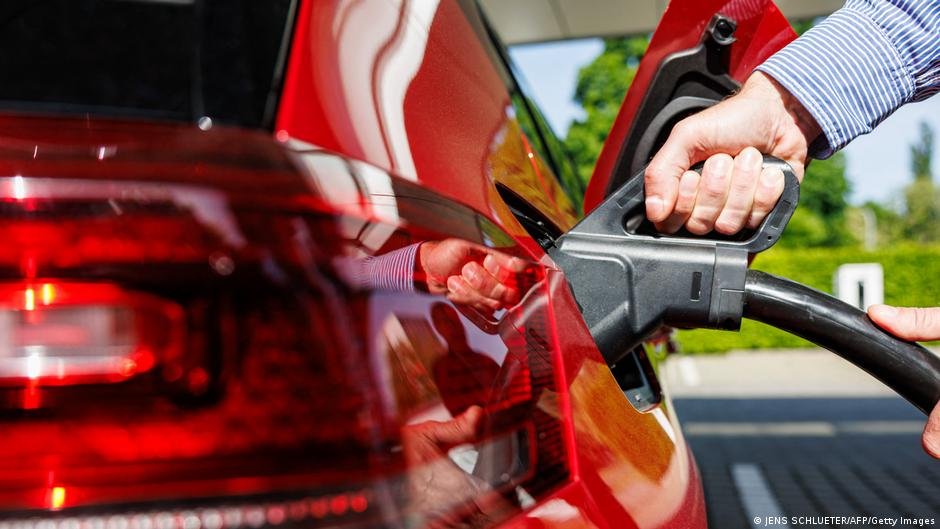
Electric vehicles (EVs) have been riding an unprecedented wave of popularity in the wake of the global oil crisis sparked by the conflict in the Middle East.
In Australia, sales jumped over 150% in April year-on-year, while in the Asia-Pacific region they rose 80% for the first three months of 2026 — excluding China, where massive sales growth has plateaued. Around 75% more EVs were sold in Latin America, and almost a third more in Europe, according to the International Energy Agency (IEA).
IEA executive director Fatih Birol said in May that record EV sales are “providing some relief now amid the largest oil supply shock in history,” and that falling battery prices will provide further industry momentum.
Still, batteries, by far the most expensive component, remain a major chink in the electric car armor. EV critics have long argued that electric car batteries, made mostly with lithium-ion, can combust, and that fires are more difficult to extinguish than in petrol cars. But this claim discounts the fact that combustion engines are much more prone to fires.
Large, heavy EV batteries have also been targeted as a potential source of increasing road damage. Yet experts counter that large trunks are by far the biggest culprit when it comes to highway wear and tear.
Calling out cobalt
Once containing critical minerals like cobalt and nickel, EV batteries have also sparked concerns about exploitative supply chains — most especially cobalt mines in the Democratic Republic of the Congo (DRC).
In Australia, a Spotlight prime-time TV news program that aired in March investigated Chinese-owned cobalt mines in Congo. It revealed them as places where thousands of people, including many children, work in terrible conditions amid severe pollution.
Citing cobalt as “the key element in practically every storage battery on the planet, from our EVs to our homes,” the program said the push for a “clean, green future” of renewables and electric cars comes at a “deadly and devastating cost.”
But critics say the report failed to mention an important point: EV battery chemistries have largely switched to lithium iron phosphate technology that requires no cobalt.
To view this video please enable JavaScript, and consider upgrading to a web browser that supports HTML5 video
David McElrea, chief executive of Australia’s Smart Energy Council, which advocates for renewable energy, questions why the story singled out EV batteries and other renewables technologies when “many other products we use contain cobalt” such as mobile phones, tablets and laptops.
Acknowledging”legitimate concerns” about exploitation in extended critical mineral supply chains for renewable energy technologies, McElrea supports investment in domestically produced critical minerals and manufacturing for batteries and solar panels. He said this would improve supply chain transparency and bolster energy independence.
The green energy advocate said the EV industry has responded to supply chain concerns and backed innovations that have removed cobalt from most contemporary electric car batteries.
“Electric vehicle manufacturers have been shifting away from cobalt because it’s expensive, toxic and ethically fraught,” wrote Neeraj Sharma, professor of chemistry at Australia’s University of New South Wales. He said cheaper chemistries based on salt (sodium-ion) batteries, for example, are also coming to market.
Controlling the critical minerals narrative
Experts are referring to a “narrative warfare” over critical minerals. Canada’s conservative and pro-fossil fuel Fraser Institute think tank issued a 2023 report claiming that some 400 critical mineral mines would be needed to keep up with EV demand.
The report’s author, Kenneth P. Green, who has long argued for investment away from renewables into “cheap” fossil fuels, said “the risk that mineral and mining production will fall short of projected [EV] demand is significant.”
However, in its 2026 Global EV Outlook, the IEA says geological reserves of critical minerals are currently sufficient for long-term EV demand — even in a scenario where most fossil fuel-powered cars are phased out. That said, a concentration of battery production in China does pose supply chain risks.
To view this video please enable JavaScript, and consider upgrading to a web browser that supports HTML5 video
The “momentum” behind lithium-free sodium-ion batteries will also reduce demand for critical minerals, noted the energy agency. The IEA is calling for a rapid rise in battery mineral recycling as a way to strengthen supply chain transparency and resilience.
‘Hit job’ or legitimate critique?
But how should the real concerns over harmful extraction and myths about EV supply chains be balanced?
While McElrea called such media EV misinformation a “hit job” by fossil-friendly media, Vlado Vivoda, an expert in critical minerals and energy security at Australia’s University of Queensland, said not every criticism is necessarily “coordinated or made in bad faith.”
“Many concerns about mineral extraction, processing, labor conditions, land impacts, waste and supply-chain concentration are real,” he told DW.
It’s why pro-transition narratives invoking “pure” clean energy can be easily critiqued, he said.
Philip Newell, communications co-chair for the global coalition group, Climate Action Against Disinformation, told DW that real concerns about “extraction injustice” need to start by “empowering local communities harmed by mining.” This could be via profit sharing, or by “strengthening and better enforcing environmental and labor laws around the world.”
Energy crisis fuels misinformation
The pushback against EVs and battery technology are potentially heightened during ongoing energy crises.
“Recent attempts to delegitimize clean technologies need to be understood partly in relation to the wider energy crisis, oil price volatility and renewed concerns about energy security,” said Vivoda.
Nonetheless, he said suggestions that clean technologies are “just as bad, or perhaps worse, than the fossil-fuel system” ultimately create “inertia” around the energy transition.
He added that the low-carbon energy transition must offer the kind of supply chain transparency that was often missing in the fossil energy sector.
“The proper response is not to romanticize ‘clean’ technology, but to compare systems honestly and govern the new supply chains much better than we governed the old ones,” he said.
Edited by: Tamsin Walker
To view this video please enable JavaScript, and consider upgrading to a web browser that supports HTML5 video
About The Author