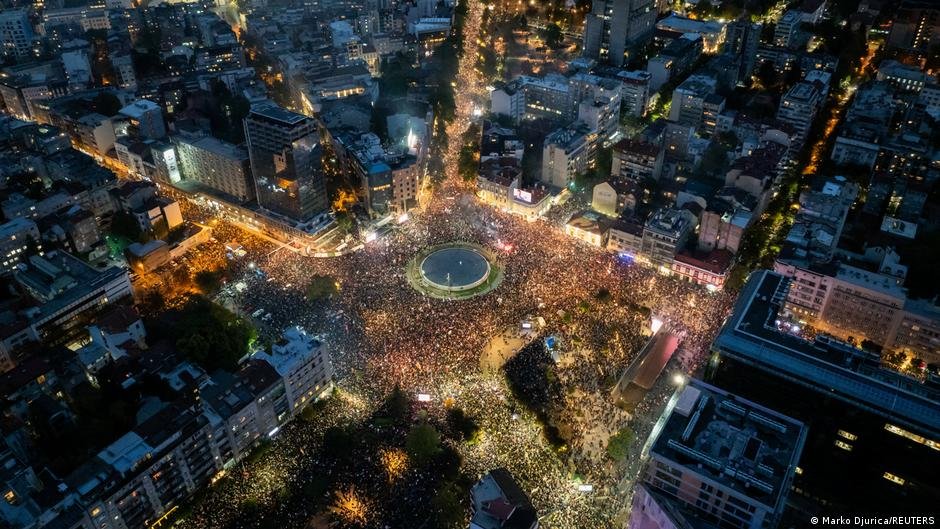
A sense of hope swept through Belgrade on Thursday evening as thousands gathered for the final rally of the Student List, the group of candidates put forward by the student movement that has been protesting against the government for almost exactly two years.
The Student List is calling for an end to the current regime in Serbia via the ballot box in Sunday’s parliamentary election.
Many of those who attended the rally had spent days walking to the Serbian capital from all four corners of the country, turning the campaign finale into a display of solidarity and peaceful determination.
“We have walked across Serbia from one end to the other, visited villages and neighborhoods, looked you in the eye and realized that we can count on you,” biology student Arsa Stojanovic told the crowd.
“People, it smells like freedom,” added Aleksandar Cupic, professor of transport and traffic engineering, and a candidate on the Student List.
Students emerge as agents of change
After 24 months of protests sparked by the collapse of a concrete canopy at Novi Sad railway station, which killed 16 people in November 2024, Serbia is heading into an election unlike any other in the 14 years since the Serbian Progressive Party (SNS) first came to power.
For the first time in years, the ruling party faces a serious political challenge, which this time comes from a student movement that has channeled widespread public discontent into an electoral campaign.
“These are the first elections since [Aleksandar] Vucic came to power in 2012 that are competitive and whose outcome is uncertain,” political scientist Dusan Spasojevic told DW. “The student movement has generated hope among citizens and substantial support. Polls suggest that they could even win more than 40% of the vote.”
The Student List has framed the election as a chance to confront corruption and demand accountability for a disaster that became a symbol of institutional failure.
In doing so, the students have sought to put aside the ideological, social and foreign-policy divisions that have long shaped Serbian politics.
SNS presents itself as a guarantor of continuity
Just a few kilometers away, also in Belgrade, the ruling SNS held its own final rally.
The message here was familiar: A vote for the SNS means stability, continuity and further prosperity, while a change of government would risk plunging the country into chaos.
The party framed the election as a battle for Serbia’s future and sovereignty, accusing its opponents of serving foreign interests.
“They tried to destroy our country on foreign orders, and that is why this is the hardest battle,” former President Aleksandar Vucic told his supporters. “They attacked us with billions of euros, and we defended ourselves with integrity, our program, love for our homeland and Serbia’s achievements.”
Rising tension
The campaign has increasingly been overshadowed by violence, reflecting a society in which political opponents are often portrayed not simply as rivals, but as enemies.
By the final week of the campaign, CRTA, an independent election-monitoring organization, had recorded 116 incidents involving physical violence or verbal threats. The incidents included physical confrontations, attacks on campaigners and attempts to seize campaign banners.
CRTA also reported that opposition activists, particularly those linked to the Student List, were also subjected to surveillance and police questioning. In some cases, the organization said, police were slow to protect opposition candidates and supporters.
Allegations of links to criminal networks
In the final runup to the election, there have also been a series of investigative reports examining alleged links between people connected to the ruling SNS and criminal networks.
Published by independent media in the days before the election, the reports have brought renewed attention to questions of corruption, political influence and accountability — issues at the heart of the student movement’s challenge to the government.
But Spasojevic is skeptical that the revelations will make a significant difference to the election outcome.
He argues that those who trust investigative media are likely to have already made up their minds, while voters who rely on pro-government outlets may never even see these reports.
Concerns about irregularities
There are also serious concerns about the fairness of the election process.
To view this video please enable JavaScript, and consider upgrading to a web browser that supports HTML5 video
CRTA told DW that the election campaign has not been either free or fair from day one, citing “a narrowing of freedoms and deepening inequality” among candidates and voters.
Its report found a pronounced imbalance in media coverage: Almost three-quarters of airtime devoted to political players on national television has featured government representatives, while more than 80% of coverage on the Student List has been negative.
Ahead of the vote, the Balkan Investigative Reporting Network (BIRN) published the testimony of a former member of the SNS, who described how public-sector employees were pressured to deliver votes for the party.
DW has also learned from sources who want to remain anonymous that voters have been offered between €30 and €150 to vote for the SNS, with holiday packages reportedly offered to entire families if they pledge all their votes to the ruling party.
What could come after the election?
Many fear a period of turbulence, uncertainty and political crisis after the vote, with election night itself a particular source of anxiety.
For weeks, the authorities have warned that students, allegedly with the help of foreign intelligence services, are preparing violence in the streets. In the final days of the campaign, several people were arrested on what the prosecution has said was the suspicion of plotting disturbances on election night.
The best-case scenario, says Dusan Spasojevic, would be a decisive victory for one of the two opposing camps, leaving little room for the other to challenge the result.
“But polls suggest that the margin will be narrow, and we will probably enter some kind of post-election crisis,” he said, adding that a narrow victory for the ruling party would almost certainly be contested, given longstanding concerns about the fairness of the electoral process and allegations that some votes may have been obtained illegally.
The EU’s reaction could be crucial
Whatever happens, the European Union‘s response could be crucial.
“I think the international response will be crucial in preventing major incidents and a further escalation of the crisis. It is the only thing that can persuade the authorities to accept defeat and refrain from an overly heavy-handed response to any protests or incidents,” he told DW.
An EU Commission spokesperson acknowledged to DW that key recommendations on improving Serbia’s electoral framework remain unimplemented and also stressed that democracy and the rule of law are key to the accession process. Serbia has been an EU candidate country since 2012.
Back in Belgrade, the students ended their rally with a kolo, a traditional Serbian circle dance, projecting confidence in their chances at the ballot box.
But the path to victory could prove difficult. The movement has vowed to defend every vote — setting the stage for a potentially tense election night if the results are disputed.
Edited by: Aingeal Flanagan