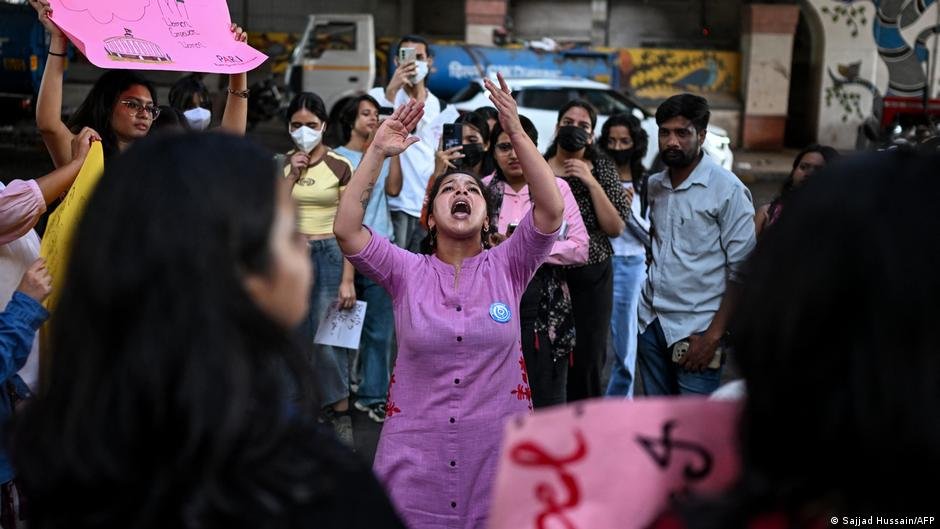
than 80 rapes reported to police every dayImage: Sajjad Hussain/AFP
This article includes accounts of rape and physical assault
Reports of the gang rape of a 17-year-old girl in New Delhi earlier this week has thrust the issue of women’s safety in India back into the spotlight.
Three men who posed as police officers took the girl away at gunpoint to a secluded part of the Aastha Kunj Park, according to local media.
Security around New Delhi’s parks has been stepped up since the incident, with a focus on improved lighting, increased security and more frequent patrols.
New Delhi park rape sparks fear across India
Anita Kunwar, an 18-year-old college student from city’s East Delhi district, said a lot has changed after what happened at Aastha Kunj Park.
“Women and girls across the city are incredibly wary, anxious, and deeply concerned about their safety,” she told DW. “An incident like this, especially in a public space where people go to relax, shatters your sense of security.”
“Reports of these ghastly sexual assaults seem to have risen in recent years,” said Deepika Singh, a university student in New Delhi. “It is as if these crimes are being normalized. It is sickening.”
“The assaults have also become more brutal and aggressive,” the 19-year-old told DW. “But I am not going to change the way I live my life because of them.”
Hundreds of students, many of them women, marched in New Delhi a few days after the alleged assault, demanding greater safety in public spaces.
“Our body is our own,” some placards read, while others demanded freedom to go out at night without fear.
Students at nearby Lady Shri Ram College have also highlighted poorly lit roads, limited police presence and gaps in surveillance around the campus.
Sexual violence across India
The concerns are not confined to one neighborhood or one city.
In Bihar state’s Jamui district, a video showing the sexual assault of a teenage girl and the beating of her male friend triggered widespread anger last month. Police arrested three minors and formed a special investigation team.
Elsewhere in Bihar, a woman was allegedly raped and brutally assaulted in a hotel room on Sunday after travelling to the Begusarai district for work. A video of the assault later circulated on social media.
Punjab’s Lovely Professional University (LPU) suspended classes and postponed mid-term examinations after a protest over an alleged rape turned violent on Sunday with protesters clashing with the police and vandalism being reported.
Why the numbers stay high
Across India, sexual violence is a major issue, with more than 80 rapes reported to police every day, according to data from the National Crime Records Bureau.
Women’s rights groups, including People Against Rape in India (PARI), have long argued that official crime statistics do not capture the full scale of sexual violence because many assaults go unreported.
The gang rape and murder of a student in New Delhi in 2012 sparked nationwide protests and led to sweeping legal reforms, including tougher penalties for offenders and the creation of fast-track courts.
But the changes have done little to reduce sexual violence. Women’s rights groups say entrenched patriarchal attitudes, understaffed police forces and delays in the justice system leave many perpetrators believing they can avoid punishment.
Can tougher policing help?
“Women’s safety is non-negotiable. Women must be safe on every street, at every hour,” said Delhi Lieutenant Governor Taranjit Singh Sandhu, while ordering the creation of a dedicated “Pink Force” of women personnel to enhance the safety of women and children in education establishments, metro stations and other locations across New Delhi.
The Supreme Court has now stepped in. On September 28, it took up the recent sexual assault cases on its own initiative and said they raised serious concerns about the way authorities were protecting women in public spaces.
The apex court has directed Delhi Police to identify vulnerable locations, improve patrolling and conduct audits of lighting and CCTV coverage in parks and other public spaces.
To view this video please enable JavaScript, and consider upgrading to a web browser that supports HTML5 video
But Yashvardhan Azad, a retired senior police officer, says the problem starts well before the police are called.
“The failure is first the society where any woman going alone at night or with a friend is viewed with suspicion,” Azad told DW. “The political climate in many states favour moral policing.”
“Public places are neglected and badly lit. Police can never be everywhere. Most importantly, recent cases reveal the municipality’s failure. Well-lit roads, better managed parks and trained guards are the answer, along with CCTVs,” he said.
Kalpana Vishwanath of Jagori, a Delhi based women’s rights group, says cities “must be designed and built to be inherently safe, inclusive and gender responsive.”
“Evaluating public spaces on nine infrastructure and social parameters, including lighting, clear walkways, transit access, crowds, the presence of women and security personnel, and natural surveillance from vendors and shops, would make them safer and go a long way in curtailing sexual violence,” Vishwanath told DW.
When reporting a crime isn’t enough
Criminal lawyer Rebecca John said police cannot be everywhere at all times but the failures continue once a case reaches them for investigation, with seizures improperly made and witness statements badly recorded.
“Many times, the police refuse to register a case because they are inclined to disbelieve the woman at the very beginning,” John told DW.
She also pointed to delays in forensic examination, emphasising that India has just seven Central Forensic Science Laboratories, alongside 32 state and 97 regional labs, adding to the time needed to process crucial evidence, often leading to acquittals or overturned rulings in higher courts.
The Supreme Court has given Delhi Police four weeks to complete audits and put stepped up patrols in place.
Whether that restores the confidence students describe losing will be tested well beyond the deadline, in the public spaces where many women continue to weigh every journey against concerns for their safety.
To view this video please enable JavaScript, and consider upgrading to a web browser that supports HTML5 video
Edited by: Keith Walker