https://p.dw.com/p/5PInrPrefer DW on Google
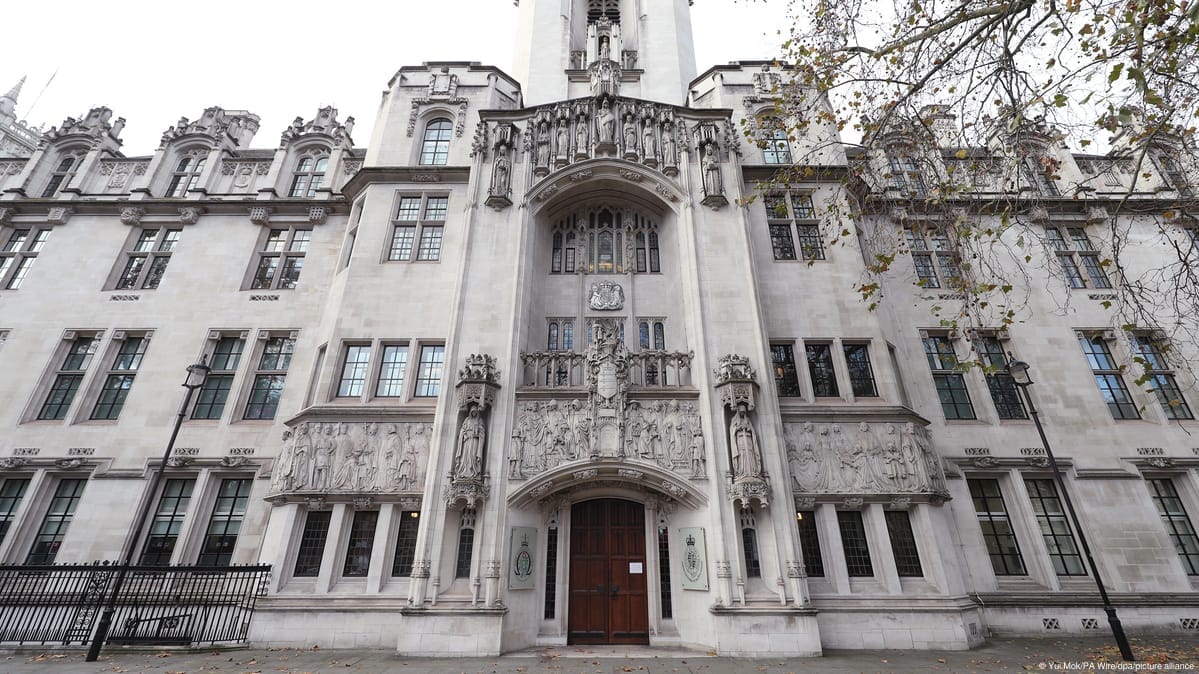
A man from Trinidad and Tobago has won a legal appeal lasting almost a decade in the last court of appeal available to him — the judicial committee of the Privy Council in former colonial power Britain.
Jason Jones, a gay man born in Trinidad and Tobago, had challenged the Caribbean nation’s Sexual Offences Act outlawing consensusal sex between adult males, saying that it breached his fundamental rights under the country’s constitution.
He initially won his case at Trinidad and Tobago‘s High Court, but the government and religious organizations managed to partially overturn the ruling once more, prompting Jones to the take the case to the island nation’s highest appellate authority — the Privy Council in the UK.
“To discriminate against somebody simply because of who they choose to love is simply ridiculous,” Jones told the Associated Press after Tuesday’s judgment was rendered.
The Privy Council in London is the final court of appeal for some Commonwealth countries including Trinidad and Tobago, although that issue was already contentious in some circles prior to Tuesday’s ruling.
What did the London court rule?
A panel of five judges unanimously allowed Jones’ appeal, dismissing a counter-appeal from the Caribbean country’s Attorney General.
It found that two sections of the country’s Sexual Offenses Act 1986, criminalizing “buggery” and “serious indecency” respectively among same-sex couples, violated Jones’ fundamental rights to private and family life set out in the 1976 constitution.
The court wrote in its ruling that “the rights and interests of Mr Jones which are at stake involve a particularly important facet of his existence and identity since the ability to form an intimate and loving relationship with another person lies at the core of the right to private and family life.”
The anti-gay laws that call for up to five years in prison have not been enforced in recent history, but critics say they still send an intimidating message.
Judge Philip Sales said as he announced the ruling that “the current understanding of the fundamental individual right to respect for private and family life is that it protects such a core part of human identity as one’s sexual orientation.”
Sales added that “laws which seek to criminalize such activities cannot be justified.”
Trinidadian authorities argued that because the 1986 laws were passed with a super-majority and constituted criminal penalties that dated back to colonial times, prior to the constitution, they could be considered “existing law” and override the individual constitutional rights in certain circumstances.
But the Privy Council judges found that the so-called “proviso” for this special status — “unless the Act is shown not to be reasonably justifiable in a society that has proper respect for the rights and freedoms of the individual” — had not been met.
One of Jones’ lawyers, Anand Ramlogan, is a former attorney general of Trinidad and Tobago and argued against this position earlier in the case.
“Constitutional rights exist precisely because majorities are not always right,” Ramlogan said. “They ensure that the dignity and equality of every citizen are not left to the changing tides of public opinion.”
Who is the appellant?
Jason Jones is a 61-year-old born in Trinidad and Tobago.
Openly gay since the age of 16, he said he fled the country in 1996 because of homophobic violence and discrimination.
Speaking to the Associated Press on Tuesday after what he termed a “stunning victory,” he said he would describe himself as a “very angry gay man,” whose anger had helped him persist in his legal appeal for so many years.
“Society has treated me worse than a criminal,” he said. “There is a real sense of vindication with this judgment. Finally, the courts are seeing that they need to step up because our politicians are so toothless.”
He said he became inspired to speak out after losing friends to HIV/AIDS and after meeting American singer-songwriter Nina Simone when she toured the island nation for three weeks in 1984, when he was 19.
“Nina was the one who said, ‘Jason, get off this rock and go see the world,’” he said, calling it a defining and life-changing experience.
To view this video please enable JavaScript, and consider upgrading to a web browser that supports HTML5 video
Trinidad and Tobago may not enforce its ‘buggery’ law, but it carries a custodial sentence
Trinidad and Tobago’s government, the country’s Council of Evangelical Churches and its largest Hindu organization, Sanatan Dharm Maha Sabha, contested the case, which has wound its way through several courts since the appeal was launched in 2017.
In 2018, Trinidad’s High Court found the laws unconstitutional. But in 2025, a local appeals court partially reversed the ruling. Trinidad’s Court of Appeals subsequently allowed Jones to seek a ruling from the final appeals court in England.
The case was being closely watched by activists across the Caribbean, with similar laws in place in several other countries in the region.
The Bahamas decriminalized homosexuality in 1991.
The UK repealed laws in overseas territories Anguilla, the British Virgin Islands, the Cayman Islands, Montserrat and the Turks and Caicos Islands in 2001.
Judges in Barbados, Dominica, St. Lucia and Antigua and Barbuda have also recently struck down similar laws.
But in former British colonies Grenada, Jamaica, Trinidad and Tobago and St. Vincent and the Grenadines it remains a crime.
The UK only decriminalized gay sex in 1967, more than four centuries after the so-called “buggery” laws were first introduced under King Henry VII, and more than a century after the last executions for the crime. People still faced prosecution or the threat of it for consensual adult gay sex until after World War II, with surely the most famous later-years case being that of computing and codebreaking pioneer and war hero Alan Turing.