


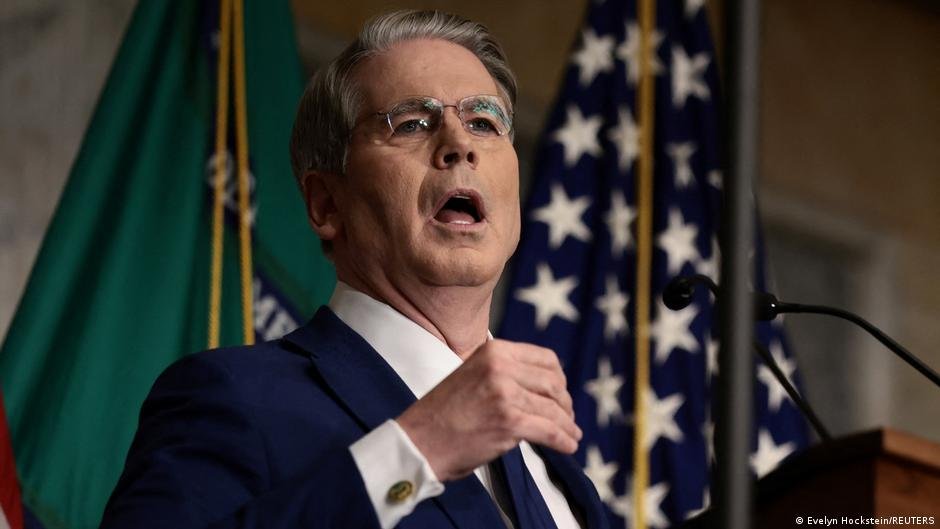
The US on Monday announced what it said would be an “unprecedented” bid to constrict Iran’s economy, by targeting its trading partners, as the war in the Middle East continues with no real resolution or progress in sight.
Treasury Secretary Scott Bessent’s much-hyped press conference did not include any solid measures or announcements, but he said to expect them to follow fairly rapidly in the course of the week.
He laid out plans for what he called the “economic asphyxiation” of the regime in Tehran, implying this would be achieved in large part via secondary sanctions on Iran’s trading partners.
“Around the globe, our objective is to sever every economic lifeline that sustains this tyrannical regime until Tehran stands alone,” Bessent told a press conference. “We are going to hold everyone accountable.”
He called the program “Operation Economic Outcast” and again sought to liken it to the “Economic D-Day” mentioned last week by US President Donald Trump, an analogy that prompted ridicule because of how poorly it seemed to fit the circumstances.
“In the Second World War, D-Day marked the historic beginning of a campaign with our Allies to target and drive the enemy from its positions, including those in third counties,” Bessent said, in an apparent effort to salvage the historical allusion.
What had Bessent said prior to Monday’s announcement?
Iran, a country that has already been living under international sanctions for decades, has vowed to retaliate.
In a post on X, Bessent described the sanctions as “the single greatest financial offensive ever marshaled against an adversary.”
He said US President Donald Trump had “dismantled Iran’s military capabilities,” destroyed nearly 100% of its military factories and “buried its nuclear program.”
“We are now entering the endgame,” he added.
Hours ahead of the announcement on Monday, Trump said Iran was “completely collapsing” in a post on social media.
‘Economic D-Day’
Last week, the US president announced what he called an “economic D-Day” for Tehran, threatening harsher sanctions targeting not only Iran but also countries that continue to do business with it.
“Our objective is to sever every economic lifeline that sustains the tyrannical regime until Tehran stands alone,” Bessent said.
Already last week, the United Arab Emirates, one of Iran’s largest trading partners and its biggest source of imports, announced that it was suspending all trade with Iran.
It was not clear if the US measures will include action against China, Russia and India.
Ahead of Monday’s press conference, China’s Foreign Ministry said Beijing was monitoring developments closely and would do what is necessary to protect its rights. The ministry also added that sanctions and pressure tactics do not help resolve problems.
How has Iran responded to the new sanctions?
Over the weekend, the head of Iran’s top security body warned that Tehran would see any country’s support of the US measures as an “act of war.”
Supreme National Security Council leader Mohsen Rezaei said Iran would “retaliate in a seismic manner” to the sanctions by targeting other oil-shipping routes from the Persian Gulf.
“If the economic war continues, not a single drop of oil will be exported, neither through the Strait of Hormuz nor from anywhere in the Persian Gulf,” Rezaei said.
The current situation in the Iran war
The Middle East war began on February 28 when Israel and the US carried out strikes on Iran, killing Supreme Leader Ayatollah Ali Khamenei. Tehran responded with strikes on energy infrastructure and US bases in the Gulf region.
While the two sides have stopped the bombing, talks to end the conflict have stalled, with control over the Strait of Hormuz remaining a key sticking point. Iran has effectively closed the waterway, crucial for global oil and gas shipments, while the US maintains a blockade of Iranian ports.
Under a memorandum of understanding signed in June, the two sides had 60 days to negotiate an end to the war and reach an agreement on Iran’s nuclear program. But that period expired last week with no signs of a deal.
Meanwhile, Pakistan’s army chief was expected to travel to Iran on Monday as part of efforts to revive diplomatic talks in the conflict.
And on Tuesday, Oman’s foreign minister is set to meet his Iranian counterpart to continue talks on the Strait of Hormuz.
To view this video please enable JavaScript, and consider upgrading to a web browser that supports HTML5 video
Edited by: Rob Turner
If you rely on our team for trusted reporting, please take a moment to select us as your Preferred Source on Google, so you’ll always see our verified news first.







