Raheela Bibi was outside playing with her siblings when a landmine exploded. It was August 2020 and she was 12, living in Pakistan. Both her hands were amputated after the incident. Her sister suffered a serious leg injury, while her brother’s eye was hurt. Bibi told DW in 2023 that though it was extremely difficult for her to do her homework, she was determined to continue with her education.
In 2025, more than 5,000 people, mainly civilians, were killed or injured by landmines or unexploded ordnance according to a preliminary analysis by the NGO Landmine and Cluster Munition Monitor. In South Sudan, 90% of the victims last year were children.
Landmines are actually designed to injure adults not kill them. This is because an injured soldier is more of a strain on an enemy country’s resources than a dead soldier. But in peacetime, landmines continue to pose a deadly threat not only to soldiers but to civilians and particularly children, who often die.
Decades after the brutal conflicts from 1991 to 2001 that were Yugoslav wars, people continue to be killed and injured by landmines in former Yugoslavia, particularly Bosnia and Herzegovina.
Ottawa Treaty in force since 1999
In 1999, there were approximately 25,000 landmine casualties per year. This prompted pressure to ban the use of anti-personnel landmines. In 1997, representatives from more than 120 countries signed the Ottawa Treaty, which became legally binding in 1999. In total, 166 countries ratified the treaty, but not China, India, Russia or the US.
Since Russia’s full-scale invasion of Ukraine in 2022, five European NATO countries, which share a border with Russia, have withdrawn from the treaty. Ukraine has also withdrawn though this will not take legal effect until the war ends.
“This is a dangerous precedent that European states, of all countries, have set,” Simone Wisotzki from the Frankfurt-based Leibniz Peace Research Institute (PRIF) told DW. “Other parties to the Ottawa Treaty, which could also face equally extreme situations in times of conflict, could take the same step. We would then have to deal with more withdrawals, which would, of course, undermine the legitimacy of the entire treaty.”
Last year, Ukraine withdrew from the treaty and justified the move citing the actions of Russia, which has never ratified the treaty and has been using mines in Ukrainian territory. “We cannot remain bound under conditions when the enemy has no restrictions,” said Roman Kostenko, the secretary of the Ukrainian parliament’s committee on national security, defense and intelligence.
If a country isn’t at war, its withdrawal from the Ottawa Treaty is supposed to take effect six months after its announcement. If it is at war, however, withdrawal should take effect only after a peace treaty has been signed. Despite the legal uncertainty, Ukraine is reportedly already using mines, albeit on a much smaller scale than Russia.
A quarter of Ukraine affected by landmines
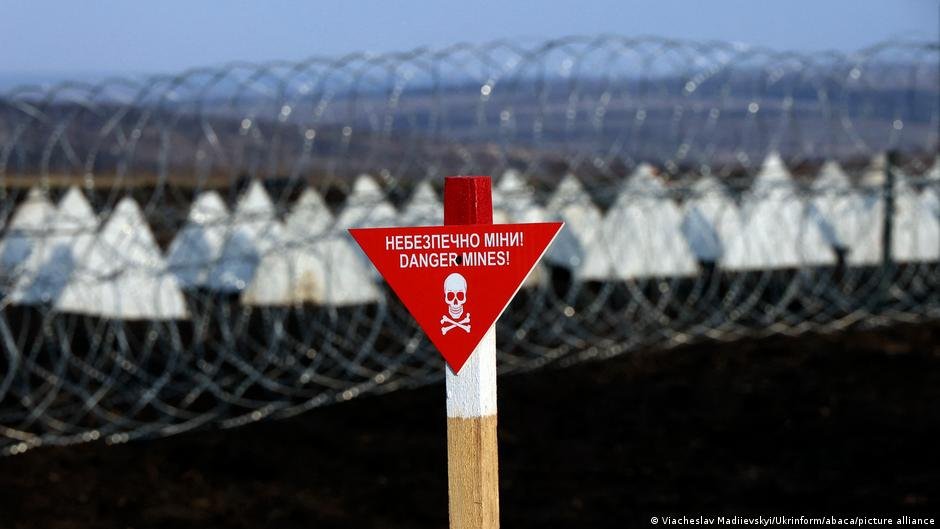
According the United Nations Mine Action Service (UNMAS), as of mid-2025 approximately 25% of Ukraine was affected by landmines and explosive ordnance. This applied not only to Ukrainian-controlled territories but also to Russian-occupied areas in the east and southeast of the country.
“Since February 2022, over 1,150 civilians have been killed or injured by landmines and explosive remnants of war (ERW),” UNMAS writes on its website, pointing out that the cost of full demining is estimated at just under $35 billion (approx. €30 billion) over 10 years.
Poland, Finland (which joined NATO after Russia’s full-scale invasion of Ukraine), Latvia, Lithuania and Estonia, which have all suffered from Russian aggression and occupation in the past, also decided to withdraw from the Ottawa Treaty last year.
Polish Prime Minister Donald Tusk has stated on several occasions that his country wants to be able to mine its eastern borders with Russia very quickly if need be. The state-owned Polish defense company Belma has been contracted to produce anti-personnel mines in large quantities. Lithuania has also announced that it will resume the manufacture and purchase of landmines.
The Finnish military has said that if mines are necessary, they should be laid responsibly, accurate maps of their position must be created and there should be precise plans for demining.
Wisotzki from PRIF said that this is progress compared to the past but that modern anti-personnel mines often have integrated sensors and smart technologies that make it difficult to remove and destroy the mines.
“That’s why I’m very critical of this and say that even new technologies present problems that, in turn, make mine clearance more difficult. In practice, mines are always laid in areas that are also used by civilians. They then remain in those territories and then injure civilians disproportionately.”
In its reports, the Landmine and Cluster Munition Monitor has pointed out that while mines that were laid during past conflicts continued to be cleared, mines continue to be laid in Ukraine or in other countries such as Myanmar.
Less arms control in the world
This comes at a time when there is increasingly less arms control. In the past few years, three major agreements between the United States and Russia have expired or been terminated: the Intermediate-Range Nuclear Forces Treaty that banned all nuclear and conventional ground-launched ballistic missiles, cruise missiles and missile launchers with intermediate range; the New Start Treaty which is a nuclear arms reduction treaty; and the Treaty on Open Skies, which set out the framework for a regime of observation flights over the territory of participating states.
In 2023, Russia’s withdrawal also effectively put an end to the CFE treaty that aimed to create a secure and stable balance of conventional armed forces in Europe and to remove the capability to launch surprise attacks or large-scale offensives
“Humanitarian arms control — which includes the Anti-Personnel Mine Ban Convention — was in effect the only area that could still be said to be working,” Wisotzki said. “And that is no longer the case.”
This article was originally published in German.