


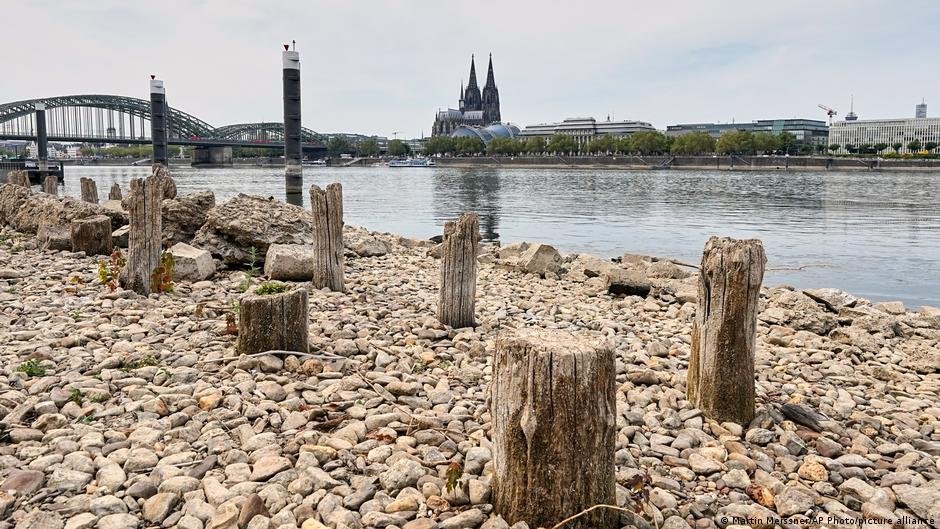
Record-breaking heat and drought are reshaping landscapes worldwide. Rivers dry up, lakes shrink, and wildfires spread. Experts warn the climate crisis is becoming more visible and severe, right before our eyes.
Image: Martin Meissner/AP Photo/picture alliance
Whether in Europe, Asia, or North America — the same is evident everywhere. Rivers are shrinking, lakes are receding, and parched soil is cracking. People are seeking relief from the heat, and animals are searching for water. The persistent heat is transforming landscapes and the daily lives of millions. Drought has long since become a global challenge.
Image: Temilade Adelaja/REUTERS
The Rhine — which flows for about 1,230 kilometers (765 miles) through six countries — has reached historic lows. Sandbars are blocking navigation, and freighters are sailing with reduced cargo. Steel production in Duisburg, western Germany, is being slowed because important raw materials are no longer arriving in sufficient quantities.
Image: Jochen Tack/picture alliance
What had been hidden beneath the surface for decades is now resurfacing. In Prahovo, in eastern Serbia, the extremely low water level of the Danube has exposed the remains of a German warship from World War II. A drone shot shows people swimming in the immediate vicinity of the wreck.
Image: Djordje Kojadinovic/REUTERS
France experienced its hottest July since weather records began in 1900. At the same time, rainfall is nearly 70% below normal. Parched soil is turning forests into powder kegs. The largest fire since 1949 has destroyed more than 42,000 hectares of land — an area four times the size of Paris.
Image: Regine Lemarchand/MAXPPP/picture alliance
An explosion echoes through the Danube as the Romanian Navy blasts underwater rocks. Drought and extreme heat have lowered the river to critical levels, threatening water supply for the Cernavoda nuclear power plant. The operation highlights the extraordinary measures countries are taking to protect vital infrastructure from the impacts of climate change.
Image: Vadim Ghirda/AP Photo/dpa/picture alliance
From the air, Lake Palas Tuzla in central Turkey looks like a work of art created by nature. In the Turkish province of Kayseri, dried-up watercourses form bizarre patterns that, from the air, resemble tree canopies. The landscape is visibly changing — and at an ever-faster pace.
Image: Sercan Kucuksahin/Anadolu/picture alliance
An aerial photograph shows the mosque and the abandoned buildings of the village of Somang in the Indonesian province of Banten. The settlement was flooded to make way for the Karian Dam, but is now reemerging from the water as a result of drought and El Nino. This unusual image illustrates the consequences of extreme weather events, as Indonesia fears water shortages and food security risks.
Image: Bay Ismoyo/AFP
In London, cricket teams play on small green islands surrounded by parched grass. Around the world, people are trying to adapt their daily lives to extreme temperatures. But in many places, water is already becoming the scarcest resource.
Image: Ben Whitley/PA Wire/dpa/picture alliance
Tourists visit Badwater Basin, the lowest point in North America, during an extreme heat wave in Death Valley National Park in California. The surreal-looking salt flat is located in one of the hottest regions on Earth. Death Valley in the US holds the official temperature record of 56.7 degrees Celsius (137 Fahrenheit), set in 1913, although some experts today doubt the historical measurement.
Image: Tayfun Coskun/Anadolu/picture alliance
The images from Germany, France, Romania, Indonesia, the United Kingdom, and the United States all tell the same story. Where water disappears, agriculture, energy supply, shipping, and nature are thrown out of balance. Drought is no longer a regional problem. It has long since become a global warning sign — and shows just how vulnerable our planet has become.
Image: Toby Shepheard/AFP10 images1 | 1010 imageshttps://p.dw.com/p/5IG9G
About The Author







