‘Easy way out’, ugly scars and unhealthy babies: Doctors debunk 10 C-section myths
What does having a Caesarean section – whether medically necessary or a woman’s choice – mean for her body, future births and her baby’s health? Gynaecologists separate myth from fact and explain what a “gentle C-section” looks like.
Some myths surrounding Caesarean sections include that a woman will not be able to have a vaginal delivery after a previous C-section. (Photo: iStock/Yuto photographer)
New: You can now listen to articles.

This audio is generated by an AI tool.

Read a summary of this article on FAST.
Get bite-sized news via a new
cards interface. Give it a try.
Click here to return to FAST
Tap here to return to FAST
FAST
Babies arrive into the world via vaginal delivery or Caesarean section. While the latter isn’t uncommon, there are still misconceptions about when it’s needed, what it entails and how it affects mum and baby.
Dr Ilka Tan, an obstetrician and gynaecologist specialising in maternal foetal medicine at KK Women’s and Children’s Hospital (KKH), said a C-section is major abdominal surgery and carries risks such as bleeding, infection, injury to nearby organs and anaesthesia-related complications.
It can be recommended for maternal reasons such as previous uterine surgeries or maternal health conditions, or foetal reasons such as a breech presentation (the baby is positioned bottom- or feet-first in the womb) or a baby that is very big or small, or has abnormalities, she added.
Other reasons include problems during labour or foetal distress, said Dr Tan, who is head and senior consultant at KKH’s Peripartum Unit.
Several things happen during the surgery. Dr Wee Wei-Wei, obstetrician and gynaecologist at Gleneagles Hospital, explained: “An intravenous antibiotic is given before the first cut, a catheter inserted into the bladder and a spinal block given to numb the mother’s lower body so she can stay awake without feeling pain during the surgery.”
Dr Wee added that the doctor cuts through seven layers of tissue to deliver the baby, after which the placenta is removed; the surgery usually takes 45 minutes to an hour, depending on the complexity.
Dr Sarah Li, consultant with the Division of Maternal Fetal Medicine at the National University Hospital’s (NUH) Department of Obstetrics and Gynaecology, said women without a medical reason for Caesarean birth are strongly encouraged to plan for a vaginal birth because “for most women that is the safer option for this and future pregnancies”.
Dr Li explained that vaginal births are safer for mothers because their recovery is usually faster, they lose less blood and do not have the risk of a C-section wound infection. For future pregnancies, there is also no concern about whether the uterine scar will hold up.
“But this is a discussion, not a directive,” she told CNA Women. “If, after a full and honest conversation about the benefits and risks of both routes, a woman still wishes to have a planned Caesarean, that decision is respected.”
BUSTING C-SECTION MYTHS
Myth #1: A C-section is the “easy way out”
Dr Li said this myth contributes to the guilt and sense of failure some women carry after an unplanned Caesarean – and that is a genuine risk factor for poor postnatal mental health.
These women may feel it’s a failure on their part to deliver “naturally” and that may contribute to anxiety and low mood in the postpartum period.
Women who have had an elective C-section may face criticism from others who are advocates of natural births, which may contribute to them feeling “less than others”, said Dr Li.
She added: “The route a baby takes into the world is a clinical circumstance, not a moral achievement, and sometimes, it is not a choice at all. A woman who has a Caesarean has given birth to her child.”
Myth #2: You can’t have a vaginal delivery after a previous C-section
KKH’s Dr Tan said vaginal birth after Caesarean section (VBAC) is discussed with all women who have had one previous C-section when they subsequently get pregnant again.
“The suitability for this depends on factors such as the reason for the first C-section, the type of uterine incision, pregnancy interval as well as individual factors such as other pregnancy complications,” she explained.
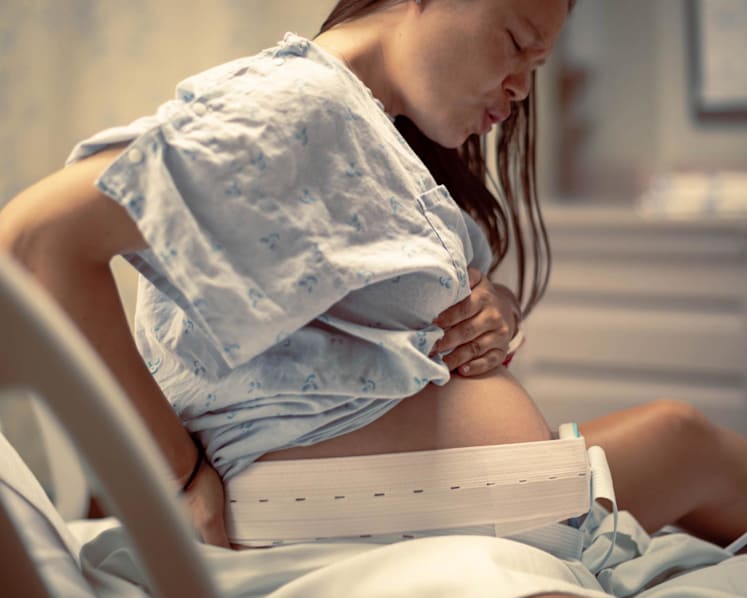
The main risk of VBAC is the scar opening during labour. After more than one previous Caesarean section, a repeat C-section is usually recommended, said Dr Tan.
While there is no evidence to suggest a maximum number of Caesarean sections, the risk of serious complications increases with each subsequent one, she added.
Myth #3: There is less postpartum bleeding (lochia) after a C-section
This is true. Dr Wee said this is because doctors often clear out the blood clots and pregnancy tissue in the uterus during the surgery. However, the actual blood loss during the C-section operation itself is typically higher than with an uncomplicated vaginal delivery.
A “GENTLE” C-SECTION
At National University Hospital (NUH), mothers can request a “gentle C-section”, which brings elements of a vaginal birth into the operating theatre.
It was introduced in 2024 “so that a Caesarean would feel less like a procedure performed on a patient and more like a birth attended by expectant parents,” said Dr Sarah Li, consultant at NUH’s Division of Maternal Fetal Medicine, Department of Obstetrics & Gynaecology.
“A Caesarean is major surgery, but it is still your child being born. Women who have had an emergency Caesarean often describe feeling like a spectator at their own baby’s birth, and that sense of dislocation can last for years.
“A gentle Caesarean is our attempt to give that moment back to the family, without compromising an inch of safety,” said Dr Li. “Nothing about the surgery itself changes. What changes is the experience around the operation.”
During C-sections at NUH, the father is present throughout the surgery and the mum may request for music to keep her calm. Also, clamping of the umbilical cord is delayed by at least one minute, allowing more blood to pass from the placenta to the baby, allowing the baby to adapt better to life outside the uterus.
In a gentle C-section, the experience is personalised further by giving her the option to “push”.
“Instead of the obstetrician simply lifting the baby out, we let mum take part in the birth,” Dr Li explained. “We bring the baby up from the pelvis, then ask her to push so that with her effort, the baby’s head gradually emerges through the uterine incision.
“She’s awake, involved, and gets to participate in that moment of birth. Usually, the analgesia isn’t so dense [as to prevent the mother from pushing].”
Collapse
Expand
Myth #4: A C-section requires a longer hospital stay
NUH’s Dr Li said an uncomplicated Caesarean takes under an hour and most women go home two to three days afterwards, often only a day longer than after a vaginal birth.
Dr Tan cited the same statistics for KKH.
Myth #5: You can’t feel anything during a C-section
A spinal block numbs the lower body so a woman can stay awake without feeling pain during surgery, said Dr Wee. She may still feel pressure as the baby is eased out, and can move her upper limbs and hear her baby cry.
Myth #6: A Caesarean leaves an ugly scar
The modern Caesarean scar is a horizontal line roughly 10-12cm long, placed low on the abdomen – below the bikini line, where the skin naturally creases, said Dr Li. It is deliberately situated so that it is covered by underwear and most swimwear.
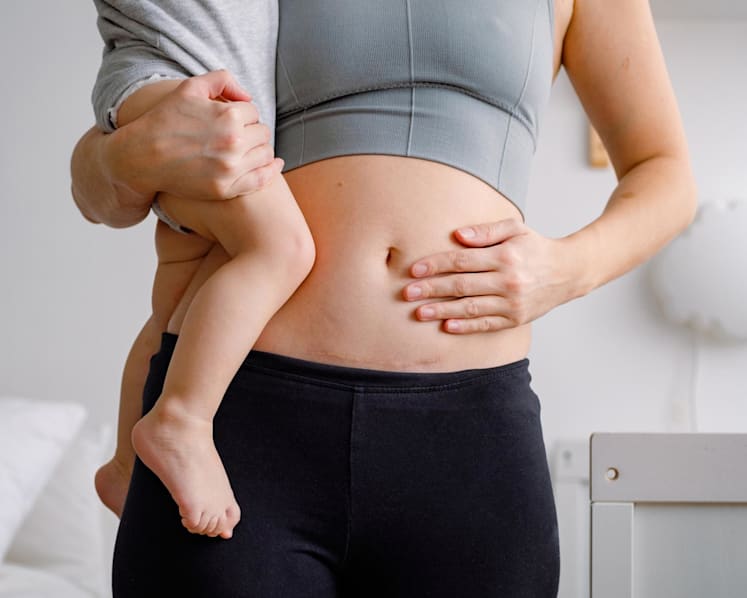
“In the first few months, the scar looks red or dark and may be slightly raised and firm; this is normal healing,” she added. “Over the following year, it typically flattens and fades to a pale, thin line that many women may even find difficult to locate.”
However, some women are more prone to thick, raised or keloid scarring; Dr Li advised mentioning this before the operation so doctors can plan for it.
Myth #7: Having a C-section prevents pelvic floor problems after delivery
A C-section reduces, but doesn’t entirely prevent pelvic floor problems after delivery, said Gleneagles Hospital’s Dr Wee, because nine months of pregnancy already place a heavy strain on your pelvic floor muscles.
“While it lowers the chance of severe muscle tearing and pelvic organ prolapse compared to vaginal birth, a C-section is a major abdominal surgery that can still lead to pelvic floor weakness, scar tissue and urinary incontinence,” she added.
Myth #8: Babies born via C-section are less healthy

KKH’s Dr Tan told CNA Women that babies born through C-section have a slightly increased risk of transient breathing problems at birth, which usually resolves without long-term problems. They also tend to have different early gut bacteria compared with babies born vaginally because they are not exposed to microbes from the birth canal.
However, she added, “it is inaccurate to say they are ‘less healthy’”.
Myth #9: You can’t have skin-to-skin contact with your baby or breastfeed after birth
Dr Wee said this is incorrect. “Most C-sections use regional anaesthesia where you stay fully awake, and medical teams routinely help you do skin-to-skin contact and start breastfeeding either in the operating room or shortly after in recovery.”
Myth #10: The name is inspired by Julius Caesar
KKH’s Dr Tan said while the exact origin of the term is uncertain, the procedure likely dates back to ancient times, when it was performed as a post-mortem procedure to save the baby.
“While believed to be named after Julius Caesar, he was unlikely born this way as his mother survived childbirth. The term possibly derives from the Latin verb caedere, which means ‘to cut’,” she added.
CNA Women is a section on CNA Lifestyle that seeks to inform, empower and inspire the modern woman. If you have women-related news, issues and ideas to share with us, email CNAWomen [at] mediacorp.com.sg.
Source: CNA/pc
RECOMMENDED
Get bite-sized news via a new
cards interface. Give it a try.
Click here to return to FAST
Tap here to return to FAST
FAST