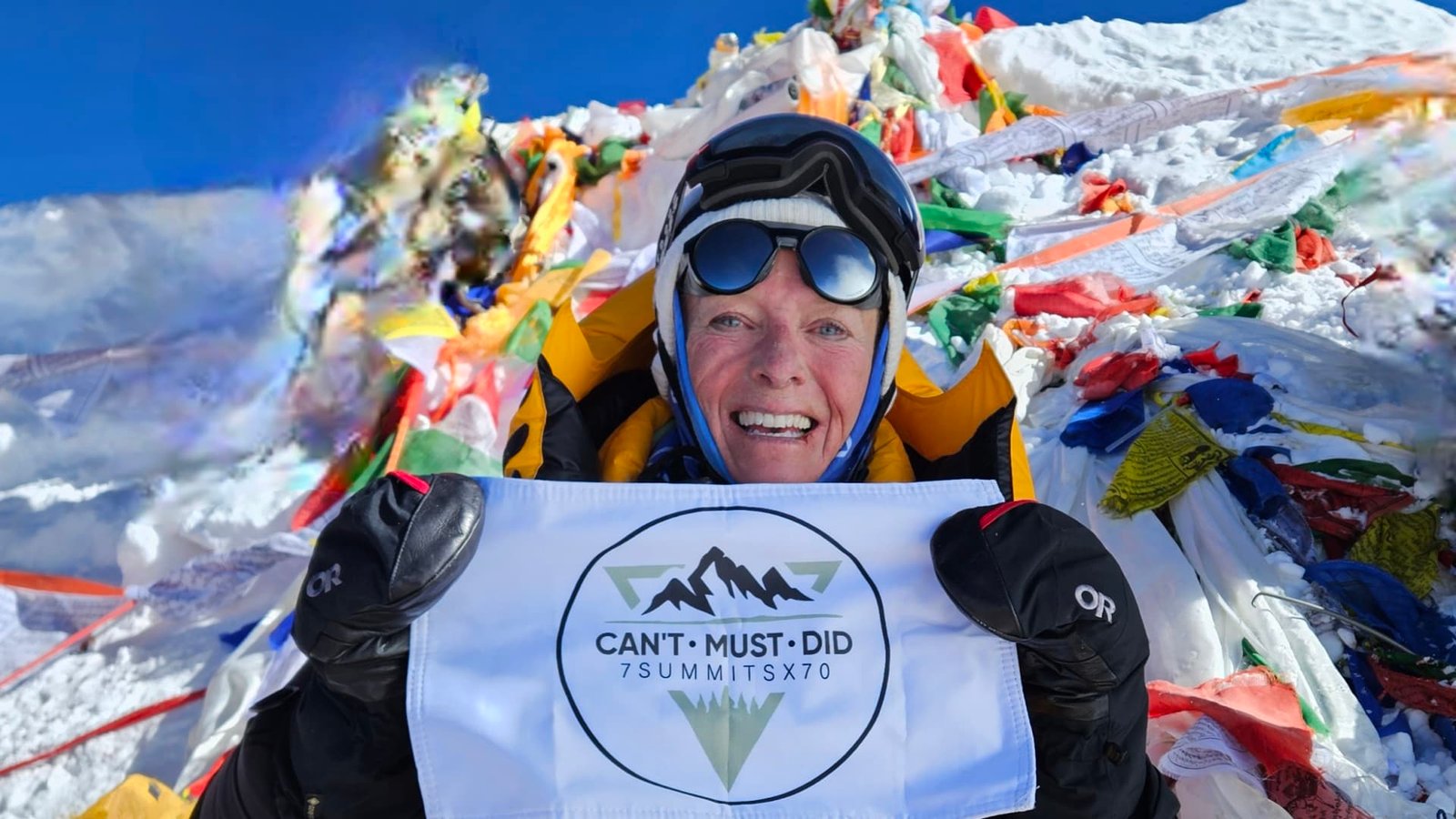
Skip NavigationAt the end of my Mount Everest experience. I was elated.Photo: Eva Steinwald
Last year, at 63, I became the oldest American woman to summit Mount Everest. That record had stood for 17 years, according to the Himalayan Database, and it was broken again five days later.
I was delighted. But beyond breaking any record, I wanted to prove that reinvention is possible at any age. I started climbing in my 60s after losing my husband Pat in 2018. I wanted to feel alive again. What began as grief slowly gave me a new sense of purpose. My goal now is to climb the Seven Summits by the time I’m 70.
So far, I’ve completed four summits: Aconcagua, Denali, Mount Everest and Mount Kilimanjaro. This summer, I’ll attempt to summit Mont Blanc. It’s the highest mountain in the Alps.
Here’s what climbing Everest taught me about mental resilience.
1. When it seems impossible, focus on the next step
During the summit push, I didn’t sleep for nearly 40 hours. Imagine functioning at almost 29,000 feet in extreme cold, wearing an oxygen mask and climbing in darkness — all while your brain desperately wants you to stop.
Above 26,000 feet, your body is deteriorating. Your brain becomes foggy and every movement feels painfully slow. The summit became too overwhelming to even think about. So I adopted a mantra: “One breath. One step. Just don’t stop.”
This mindset followed me off the mountain. Now when I feel overwhelmed, I use this mantra to work through hard times.
One foot in front of the other. My mantra on the mountain, and in life, is “One breath. One step. Just don’t stop.”Photo: Eva Steinwald
2. Patience is the antidote to wanting to quit
I spent six weeks at Everest Base Camp. The actual summit climb took four days to get to the top, and one day to descend.
The climb itself is certainly difficult, but my resilience was truly tested while I waited out weather alone in my tent. I did my best to focus on the present moment. I would also talk to my late husband, Pat.
I learned that resilience sometimes means staying patient during times of uncertainty.
My view of the Everest summit from Camp 4. Almost there.Photo: Eva Steinwald
3. It’s never too late to change your view of yourself
When I first started doing this, I had no idea what it took to train for an expedition. I figured I would do strength workouts and run. I definitely felt stronger, but I was nowhere near ready to actually attempt a summit.
I started researching high altitude trainers and programs and realized how little I knew. I hired a coach that specialized in high altitude acclimatization and mountaineering and that changed everything. I have trained with my coach every week for the last two years.
For most of my life, I never thought of myself as an athlete. Now I do. My habits and my discipline have completely transformed. I’ve taken the word “can’t” out of my vocabulary.
Ready for the elements and whatever the day has in store.Photo: Eva Steinwald
4. Staying mobile matters more than pushing harder
I train hard with weighted packs, elevation hikes, Stairmaster sessions, and endurance days. But I’ve learned that longevity comes from balance, not punishment.
There were times when I was preparing for Everest when I was tired, fatigued and my knees flared up. Instead of forcing it, I had to learn to give my body grace. This was hard for me to do. I am someone who always wants to go, go, go.
But my coach told me: “You need your body to recover to get stronger.” I didn’t want to make myself more prone to injury, not when this was so important to me.
Now I let myself rest when I need it. I stretch, walk, hydrate and sleep. I move gently instead of aggressively. These mountains have taught me that consistency beats intensity every time.
Me descending the Hillary Step. It is a 40-foot vertical rock face.Photo: Eva Steinwald
5. True happiness doesn’t come from external sources
Everest doesn’t care who you are, or about age, titles and accomplishments. The mountain strips life down to its essentials very quickly.
When I was there, I became so aware of my breathing, thoughts, fears and choices. Ironically, in those moments is where I ultimately found the most peace.
I realized happiness comes from within: purpose, growth, gratitude and becoming stronger than the person I used to be.
The view is one I will never forget.Photo: Eva Steinwald
Eva Steinwald is a real estate broker, martial arts school owner, and mountaineer based in Idaho. After the loss of her husband in 2018, she embarked on a mission to climb the Seven Summits by age 70, while raising awareness about climate change. Since January 2024, she has successfully summited Aconcagua, Denali, Kilimanjaro, and Mount Everest, reaching Everest’s summit at age 63 in 2025.
Want to get ahead at work? Then you need to learn how to make effective small talk. In CNBC’s new online course, How To Talk To People At Work, expert instructors share practical strategies to help you use everyday conversations to gain visibility, build meaningful relationships and accelerate your career growth. Sign up today!