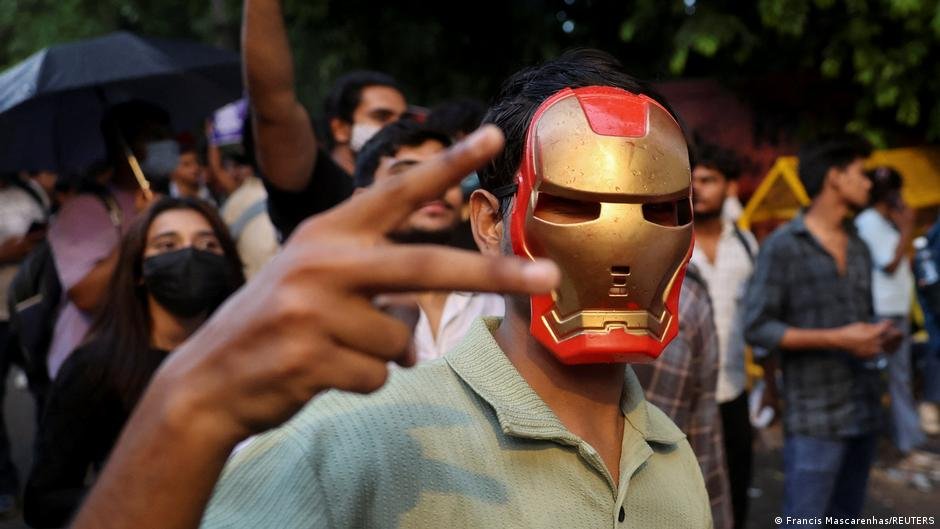
The crowds have long dispersed from the Cockroach Janta Party’s (CJP) main New Delhi protest site next to the Jantar Mantar.
But the CJP’s 36-day campaign, which started as a satirical protest against exam leaks and grew into a wider movement voicing young Indians’ anger over jobs and education, has entered a new phase.
The authorities and the CJP are now battling to shape how India’s first Gen Z-led protest will be remembered.
Education Minister Dharmendra Pradhan resigned on July 25, fulfilling one of the CJP’s key demands after weeks of protests that withstood tear gas and baton charges.
India’s ruling Bharatiya Janata Party (BJP) says the minister’s resignation demonstrates government accountability, while the CJP argues it was a concession won through sustained public pressure.
The BJP has mounted a coordinated online campaign aimed at reframing the movement, observers say.
MPs Bansuri Swaraj and Sambit Patra have shared videos of protesters allegedly abusing Indian Prime Minister Narendra Modi and his late mother, while Modi himself said he forgave those responsible.
Meanwhile, BJP leaders J P Nadda and Pradhan have argued that opposition parties and “anti-national forces” sought to exploit genuine student grievances for political gain.
BJP spokesperson Shazia Ilmi rejects suggestions that the party is trying to divert attention from education reform.
“A generation capable of reinventing political communication through memes and satire should not have fallen back on crude abuse,” Ilmi told DW, referring to slogans directed at Modi and his late mother.
The meme war
CJP supporters tell a very different story.
Instead of lengthy political rebuttals, they have continued to flood Instagram with memes, parody reels and remix videos that mock the BJP’s attempts to appear youthful, while insisting the central issue remains education reform and accountability.
Apar Gupta, founding director of the Internet Freedom Foundation, believes the Cockroach movement exposed a generational shift in political communication.
Gupta said that the BJP’s digital strategy was designed for the WhatsApp era.
“Instagram is a different ecosystem,” he told DW. “It rewards authenticity, personal storytelling and virality, allowing Gen Z creators to set the terms of debate before official narratives can catch up.”
“Gen Z may have won the cultural conversation through reels, memes and satire, but the state still retains institutional power through takedown requests, digital surveillance and investigations,” Gupta said.
“The battle is no longer just over public opinion; it is over how the protests will be remembered.”
CJP creators frequently juxtapose government announcements with unemployment statistics, canceled exams and footage from the protests.
When BJP leaders adopted Gen Z slang on party-linked accounts, students responded with satire, portraying the outreach as awkward and performative rather than authentic.
Some of the movement’s most widely shared content relied on humor rather than slogans.
“Get Ready With Me” videos showing students padding their clothes before facing police batons, clips filmed inside police vans and self-deprecating memes about arrests kept the movement alive online long after the tents at Jantar Mantar were dismantled.
For Neha Bora, president of the All-India Students’ Association (AISA), the government’s response follows a familiar script.
“This is nothing new,” she told DW. “They are attempting to shrink what was a broad-based student movement into a communal story because that serves their political agenda.”
Instagram changes the rules
For years, the BJP set the pace of India’s online political conversation.
To view this video please enable JavaScript, and consider upgrading to a web browser that supports HTML5 video
Modi’s 2014 campaign, widely described as India’s first “Twitter election,” transformed social media into a powerful electoral tool.
The Cockroach movement suggested that model may no longer be sufficient.
Questions about digital power extended beyond political parties, however, when Meta temporarily removed one of Modi’s videos during the protests before restoring it and apologizing, attributing the removal to an automated moderation error.
For the BJP, the episode became evidence that global technology platforms were actively shaping political narratives.
Senior leaders, including Nishikant Dubey, chairman of Parliament’s Standing Committee on Communications and IT, questioned Meta’s actions after Modi’s video was briefly removed, saying it raised “serious questions” about the platform’s intent.
Beyond the hashtags
Media commentator Pamela Philipose, who researches social media and social movements, believes it was inevitable that attention would eventually move beyond the demonstrations themselves.
But she argues that would represent a failure if the underlying questions disappear with the hashtags.
“The real issue is whether India can build an education system that offers fairness, credibility and opportunity to millions of young people,” Philipose told DW. “Reforming examinations is only one part of that larger democratic challenge.”
Philipose emphasizes that the CJP’s real achievement was not simply forcing a ministerial resignation but enabling young people to tell their own story without relying on traditional media.
Gupta argues that, regardless of who wins today’s narrative battle, something more fundamental has changed.
“A generation that treats the internet as its civic square, and defends it with wit, is India’s constitutional guarantee of free speech working as intended,” he said.
Whether the BJP succeeds in reclaiming the narrative or the CJP keeps the focus on education reform remains uncertain. What is already clear is that India’s first digital-native protest did not end when the tents came down at Jantar Mantar.
It has simply moved online, where reels, memes and competing political narratives are shaping how the movement will be remembered.
Edited by: Keith Walker