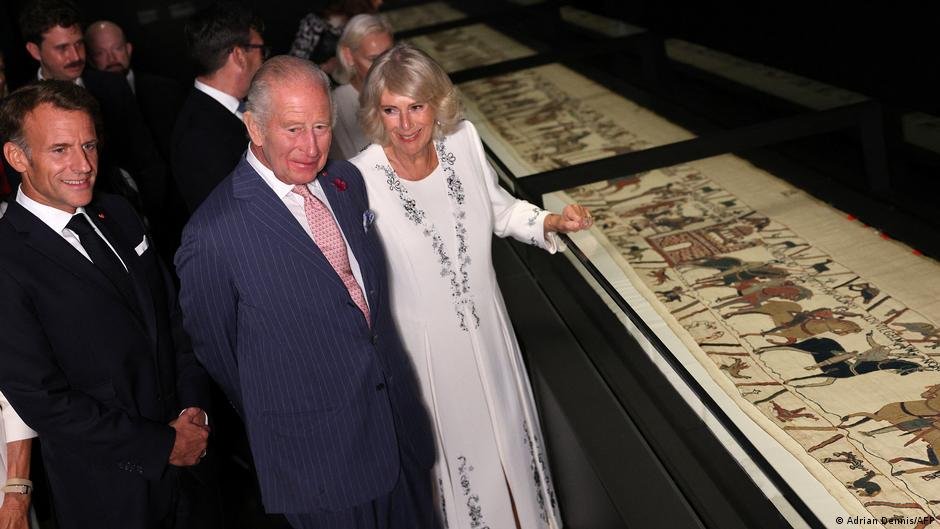
French President Emmanuel Macron began a two-day trip to the UK by visiting another famous new arrival from France, the Bayeux Tapestry, with King Charles III and Prime Minister Andy Burnham.
Macron and his wife Brigitte, and Burnham and his wife Marie-France van Heel joined King Charles and Queen Camilla to walk the length of the 70-meter tapestry in the British Museum.
Why is the Bayeux Tapestry in London?
The tapestry, which depicts the momentous events of 1066 culminating in William the Conqueror of Normandy claiming the English throne, is on temporary loan from its usual home in France. It’s the first time it’s touched British soil since its creation in the 11th century.
The embroidery is on loan for a 10-month exhibiton opening to the public next week, on September 10. The exchange was first announced during Macron’s state visit last year.
Though it’s thought to have been made in the British Isles, it had been on French soil ever since the 11th century. It’s usually on show in Bayeux in Normandy in northern France, hence the name. The effectively priceless artefact was transited across the Channel in secret in July.
Prime Minister Burnham, who took office six weeks ago, called the tapestry’s return “a landmark moment” in the history of the two countries.
He also hailed ties with Macron’s French government more generally in the House of Commons on Wednesday, alluding to reduced illegal migration crossings of the English Channel — a bid to counter one of Reform UK’s favorite summer talking points.
“The loaning of the tapestry is a great example of French-British cooperation — the same cooperation that has helped us reduce summer small boat crossings to a seven-year low,” Burnham said.
It’s Macron’s first UK visit since Burnham took office and their first in-person meeting as leaders.
What is the Bayeux Tapestry?
The Bayeux Tapestry is a 70-meter long artwork, which is thought to be incomplete, depicting the Norman conquest of England in 1066.
Norman forces led by William the Conqueror were able to defeat and dethrone King Harold Godwinson in a campaign culminating in victory at the Battle of Hastings. The tapestry famously depicts Harold being shot in the eye with an arrow, as he is said to have died — admittedly in what modern historians believe is likely a myth or artistic exaggeration.
This conquest was a crucial contributing moment in the establishment of what would become England and later the British Empire and the UK. It was the last of several successful foreign invasions of England in a millenium, and turned out to be the last one for a millenium.
The conquest also added the final core ingredient, French, to the linguistic melting pot that produced the modern English language.
The embroidered cloth, which has brief Latin titles captioning its 58 scenes, is widely accepted to have been made in England as a tribute to William after his victory. It was then transported to his family home in Normandy.
Edited by: Elizabeth Schumacher
If you rely on our team for trusted reporting, please take a moment to select us as your Preferred Source on Google, so you’ll always see our verified news first.