https://p.dw.com/p/5PtkNPrefer DW on Google
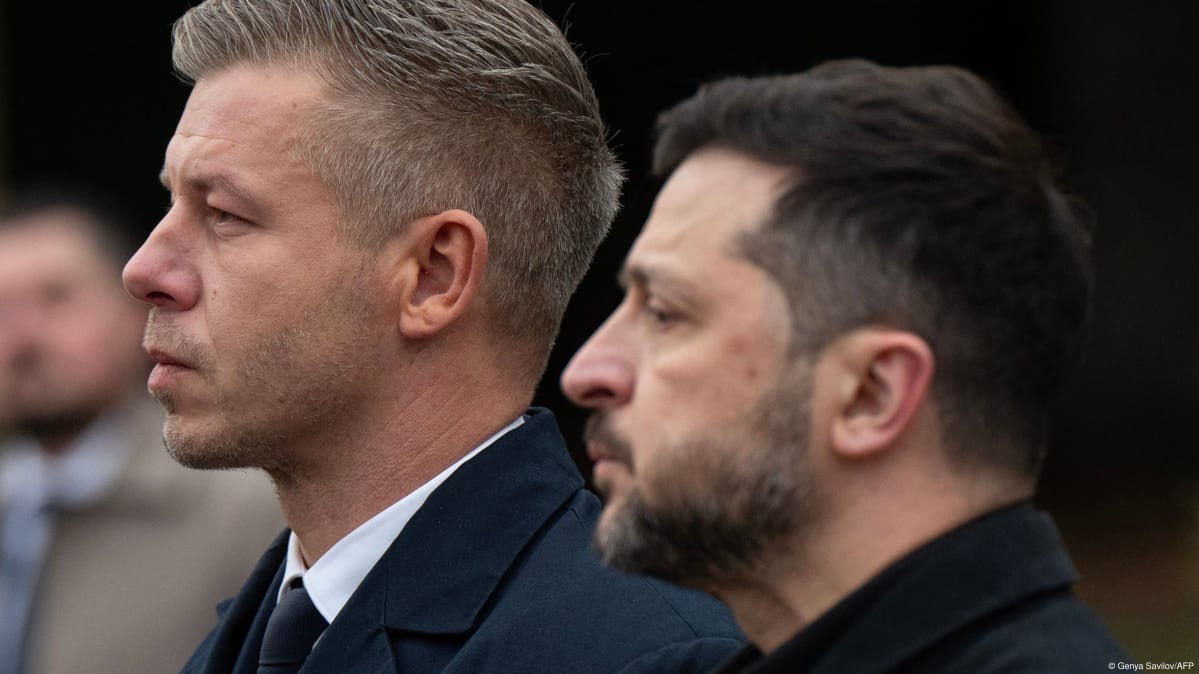
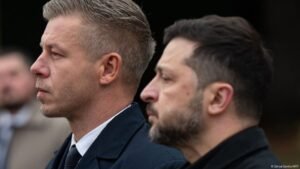
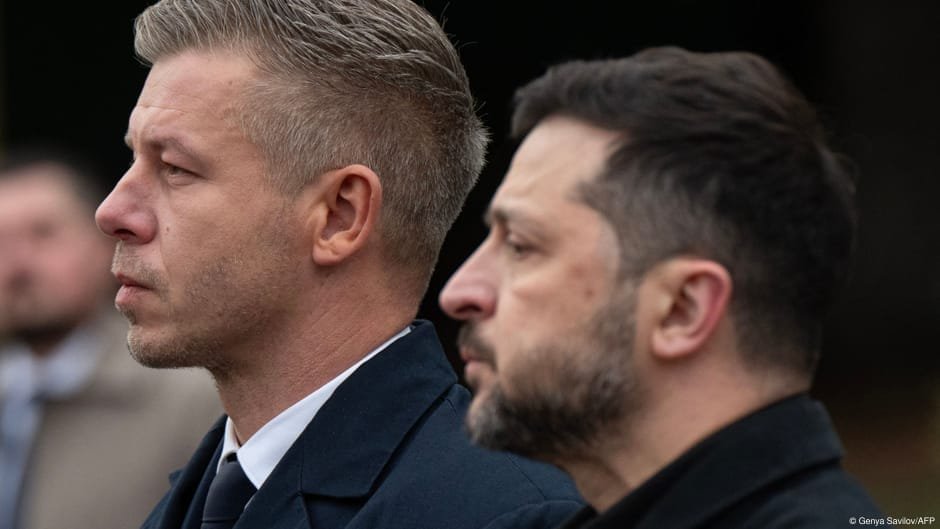
The location and the gesture were carefully chosen: Hungarian Prime Minister Peter Magyar and Ukrainian President Volodymyr Zelenskyy stood side by side, laid flowers and bowed their heads at the military cemetery in the center of the Ukrainian city of Uzhhorod.
One of those buried there is an ethnic Hungarian who was one of the first soldiers killed in Russia’s full-scale war of aggression against Ukraine.
Magyar intentionally chose not to begin his first visit to Ukraine as prime minister at a government building. Instead, his Tuesday afternoon visit began at a place where he could demonstrate his solidarity with Ukraine more clearly than anywhere else.
Uzhhorod, known as Ungvar in Hungarian, is the capital of Ukraine’s Transcarpathia region, which is home to around 80,000 members of Ukraine’s Hungarian minority. Thousands of ethnic Hungarians are fighting Russian occupying forces on the front lines.
For Hungary, where ethnic Hungarian minorities in neighboring countries traditionally play an important role, the war is therefore closer to home than it is for other European countries.
Magyar described his visit to Ukraine as a “historic day” in a Facebook post. Before the ceremony at the cemetery in Uzhhorod, he said: “I bring with me the solidarity of the Hungarian people. We stand with Ukraine against the Russian aggressor.”
Zelenskyy responded on X, saying “We appreciate this gesture of respect toward those who sacrificed their lives for Ukraine’s independence.”
From low point to fresh start
The meeting between Magyar and Zelenskyy marked a turning point in Hungary’s approach to Ukraine.
The two leaders repeatedly shook hands throughout the day. Such scenes would have been unthinkable just a few months ago. The propaganda of Magyar’s pro-Russian predecessor, Viktor Orban, portrayed Ukraine as a “mafia state” and “lawless country” on an almost daily basis.
Under Orban, relations between Hungary and Ukraine reached a historic low.
Now the two countries are seeking a political reset, which is important not only for Hungary and Ukraine but for Europe as a whole. After all, Orban’s repeated obstruction of support for Ukraine drove the EU to the brink of despair.
Closer economic cooperation
During talks in Uzhhorod, the two leaders also agreed to closer economic cooperation.
The talks centered on Hungarian diesel supplies to Ukraine, greater use of Ukrainian gas storage facilities by Hungarian companies, and joint infrastructure projects, including the opening of new border crossings and a direct rail link between Budapest and Kyiv.
Nevertheless, no formal agreements were signed on Tuesday.
At a subsequent news conference, journalists asked questions about sensitive issues between the two countries: minority rights, Ukraine’s EU integration and a new EU loan for Ukraine.
Throughout the day, the two men were visibly keen to avoid any discord.
Magyar, for example, described his angry outburst over Ukraine’s “Carpathian Eight” initiative in parliament in late September as a “misunderstanding” and suggested that Hungary might, after all, take part.
Zelenskyy’s cautious replies to journalists suggest that he knows his country’s path to EU membership also runs through Budapest.
A fresh — but not always smooth — start
One of Magyar’s statements on Tuesday was key: “We’ve finally put a stop to this completely unnecessary and inexplicable political escalation.”
Even before taking office in early May 2026, Magyar had promised to reset relations with Ukraine. But the process has not been entirely smooth.
In many respects — but certainly not all — Magyar is distancing himself from his predecessor. He has made no bones of the fact that he sees Russia as the aggressor, but he rejects both arms deliveries to Ukraine and even the transit of weapons across Hungarian territory.
Magyar previously accused Ukraine of treating ethnic Hungarians as second-class citizens — a claim that is not borne out by the facts. He pressed for greater minority rights and for a time blocked the opening of negotiating chapters in Ukraine’s EU accession talks.
Magyar also departed from diplomatic convention by choosing the location of his meeting with Zelenskyy in Ukraine: Indeed, it was Magyar who invited Zelenskyy to Transcarpathia.
Hungarian attitudes to Ukraine
Magyar’s sometimes confrontational tone toward Ukraine can also be explained by the need to avoid appearing too pro-Ukrainian to the Hungarian public.
According to a November 2026 poll conducted by the think tank Globsec, 33% of Hungarians would now support their country providing military aid to Ukraine. Although this is much more than during Orban’s time in office, many Hungarians remain skeptical of Ukraine.
That’s why Olena Halushka, a Ukrainian political scientist at the International Centre for Ukrainian Victory (ICUV), sees some aspects of Magyar’s visit as a concession to public opinion in Hungary.
“Magyar has taken over a deeply polarized country,” she told DW’s Ukrainian Service. “A visit to Transcarpathia is more of a step for the Hungarian population than for Ukraine.”
Ukraine accommodated not only Magyar’s choice of location but also Hungary’s demands for better protection of minority rights, which were set out in a 10-point plan in June. That’s because EU integration is one of the country’s top political priorities.
After planned restrictions on the use of minority languages were withdrawn in late 2023, Ukraine’s parliament in early October passed a law on minority language rights that in some respects goes even further than European standards.
Hungary subsequently dropped its obstruction of the opening of negotiating clusters for Ukraine’s EU accession.
‘Historic’ meeting
Laszlo Zubanics, chairman of the Hungarian Democratic Federation in Ukraine (UMDSZ, one of two Hungarian political parties in Transcarpathia), told DW that the Magyar-Zelenskyy meeting was “historic.”
He particularly welcomed the fact that Ukraine will probably implement practical improvements in the protection of minority rights “not only by the end of 2027, but much sooner, within just a few months.”
A Hungarian diplomat who spoke to DW on condition of anonymity also called the meeting “historic,” adding that after the Orban government’s anti-Ukrainian policies, trust now needs to be rebuilt, and that personal meetings between the two leaders play an important role in that process.
The diplomat went on to say that Hungary not only wants to ensure that the rights of the Hungarian minority are protected, it also has a strong interest in being involved in Ukraine’s reconstruction.
Overall, the diplomat concluded, both sides are very keen to expand economic cooperation.
A path forward
Hungarian political scientist Daniel Hegedus of the Institute for European Politics (IEP) in Berlin told DW that while the meeting was a “symbolic milestone,” it will be important to see “how the two political leaders capitalize on the symbolic political capital generated by this meeting.”
No observers have suggested that this is the grand finale of reconciliation between Hungary and Ukraine.
Nevertheless, Tuesday’s reset sends an important signal to Europe, namely that if the political will is there, a deep gulf that has existed for years can be transformed into a set of diverging interests that can be addressed through negotiations.
Or, as Zelenskyy put it, now there are “all the opportunities to build hopefully constructive relations.”
This article was originally published in German.