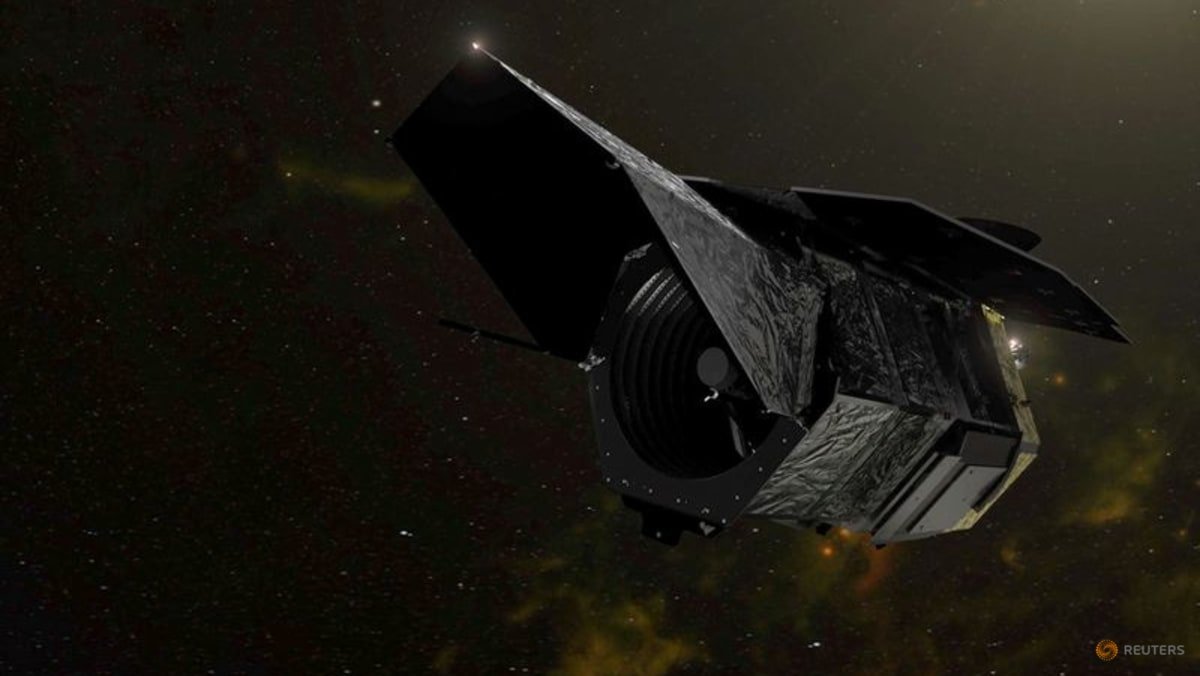
New NASA telescope to probe dark energy, dark matter and exoplanets


Read a summary of this article on FAST.
Get bite-sized news via a new
cards interface. Give it a try.
Click here to return to FAST
Tap here to return to FAST
FAST
Aug 25 : NASA is preparing to launch its next flagship space observatory, one that scientists plan to use to investigate some of the universe’s biggest mysteries including dark energy and dark matter, while also testing gravity at vast scales and hunting for planets beyond our solar system.
The launch of the Nancy Grace Roman Space Telescope, a roughly $4 billion project, is planned for Sunday at NASA’s Kennedy Space Center in Florida, with the observatory to be lofted into orbit aboard a SpaceX Falcon Heavy rocket. The launch comes nine months ahead of schedule, according to U.S. space agency officials.
Roman is a follow-on to the Hubble Space Telescope, launched in 1990, and the James Webb Space Telescope, launched in 2021, and has capabilities that can expand on the knowledge gained by those pioneering observatories, both of which continue to operate.
The new telescope’s panoramic view of space and its rapid survey speeds offer the opportunity for scientists to study the cosmos as never before, with wide-field surveys examining its structure, composition and evolution.

Guess Word
Crack the word, one row at a time

Buzzword
Create words using the given letters

Mini Sudoku
Tiny puzzle, mighty brain teaser

Mini Crossword
Small grid, big challenge

Word Search
Spot as many words as you can
THE WEIRD, THE RARE AND THE UNUSUAL
“Roman’s vast reach will allow us to find the weird, the rare and the unusual,” Julie McEnery, Roman’s senior project scientist at NASA’s Goddard Space Flight Center in Maryland, told reporters.
“Roman’s primary instrument combines exquisite performance and sensitivity with the ability to quickly and efficiently survey the large regions of the sky,” McEnery said.
The telescope’s main survey will take more than a year, McEnery said.
“The survey will contain over two billion galaxies and enable us to study how the structures in our universe — the stars, the galaxies, the clusters of galaxies — grew and evolved. We’ll also measure how our universe has expanded over time. And these are the keys that will allow us to unlock the fundamental nature of dark matter and dark energy and the fabric of the universe itself,” McEnery said.
The Big Bang event roughly 13.8 billion years ago initiated the universe, and it has been expanding ever since. Scientists in 1998 disclosed that this expansion was actually accelerating, with an invisible force called dark energy as the hypothesized reason.
The universe’s contents include ordinary matter — stars, planets, gas, dust and all the familiar stuff on Earth — as well as dark matter and dark energy, whose physical nature remains unknown. Ordinary matter represents perhaps 5 per cent of the contents. Dark matter, known through its gravitational influences on galaxies and stars, may represent about 27 per cent. Dark energy may represent about 68 per cent.
“The key questions are: Is dark energy simply a property of empty space that remains constant over time, or does it evolve in time?” cosmologist Mustapha Ishak of the University of Texas at Dallas, a member of Roman’s scientific collaboration, told Reuters.
“The recent results from the DESI — Dark Energy Spectroscopic Instrument — collaboration indicate tantalizing hints of a time evolution of dark energy. Could the observed acceleration instead indicate that our theory of gravity needs modification on the largest scales? Answering these questions is one of the most important goals of modern cosmology,” Ishak said.
EINSTEIN’S THEORY
Physicist Albert Einstein in 1915 presented his theory of general relativity explaining gravity, and it remains foundational.
Roman will map how galaxies cluster and how matter bends light through a phenomenon called gravitational lensing.
“These measurements allow us to test whether Einstein’s theory remains valid across billions of light-years or whether modifications to gravity (theory) are required,” said Ishak. “This is important because it addresses one of the most fundamental questions in physics: What law governs the universe on its largest scales?”
To date, more than 6,350 exoplanets — planets outside our solar system — have been discovered, as scientists search for evidence of potential life beyond Earth.
Roman will conduct one of the most comprehensive searches ever for exoplanets. It is expected to discover thousands of new ones and provide the first statistical census of planetary systems similar to our own. It also will demonstrate new technology to directly image some relatively nearby exoplanets.
After launch and separation from the rocket, the telescope will travel toward a location called Lagrange Point 2, situated about a million miles (1.6 million km) from Earth, about four times the distance to the moon. Webb also resides at this orbital location. Hubble is in low-Earth orbit.
Roman’s mission is planned for five years, though NASA said the telescope may have enough fuel for five additional years. U.S. President Donald Trump’s administration tried during both his first and second terms to reduce or eliminate funding for Roman, but Congress preserved it.
The telescope is named after Nancy Grace Roman, NASA’s first chief astronomer. Roman died in 2018 at age 93.
Source: Reuters
Sign up for our newsletters

Get the CNA app
Stay updated with notifications for breaking news and our best stories
Get WhatsApp alerts
Join our channel for the top reads for the day on your preferred chat app

Get bite-sized news via a new
cards interface. Give it a try.
Click here to return to FAST
Tap here to return to FAST
FAST