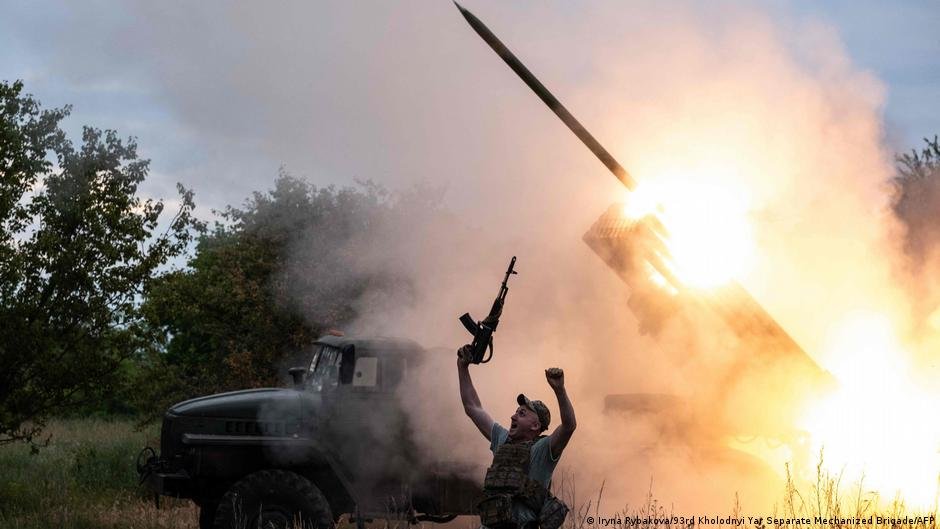
“Warlord” is a term that was commonly used in the 1990s in connection with civil wars in Liberia, Afghanistan and Somalia. During that time, it was used to describe leaders who waged war to further their own interests, with no regard for the degradation of countries. The 2026 Peace Report from four leading German peace and conflict research institutes focuses on the comeback of such actors in the 21st century.
“The new warlords undermine the international order,” said Conrad Schetter from the Bonn International Center for Conflict Studies as he launched the report on Monday in Berlin together with three other institutes. The conflict researchers listed several names, including Russian President Vladimir Putin, US President Donald Trump and Israel’s Prime Minister Benjamin Netanyahu.
Schetter accused them and others of essentially the same thing: “Using military violence is their preferred method of advancing their interests. In doing so, they do not care about international law.” Schetter’s colleague, Ursula Schröder from the Institute for Peace Research and Security Policy at the University of Hamburg (IFSH) added: “We don’t want to equate anything, but we do see patterns,” referring to Putin, Trump, Netanyahu and other people in power.
To view this video please enable JavaScript, and consider upgrading to a web browser that supports HTML5 video
Violence as ‘a normal instrument of politics’
The authors of the Peace Report said they recognize a pattern in the renewed and preferred application of violent force by certain actors as a “normal instrument of politics.” In doing so, these actors also attempt “to curtail the political sovereignty of other countries,” in the interests of profit and expanding power.
According to the study, this also applies to several Gulf states: Saudi Arabia, Qatar and the United Arab Emirates. “They are involved in numerous civil wars, from Libya to Somalia,” conflict researcher Schetter said. For them, it is also about advancing their geopolitical, strategic or economic interests.
Less development cooperation and humanitarian aid
This is why the warlord theme is prevalent throughout the study, including in its title, Nicole Deitelhoff from the Peace Research Institute Frankfurt (PRIF) explained: because they accelerate the collapse of the international order. She pointed to the United Nations as an example.
To stop this trend, she said she expects more engagement from Germany and Europe: “We urge them to find partners in order to sustain a system of rules.” She and the other experts consider financial cuts to development cooperation and humanitarian aid to be the wrong path to this end. Such withdrawal strengthens crisis dynamics, they said in a joint statement.
To view this video please enable JavaScript, and consider upgrading to a web browser that supports HTML5 video
More hunger, more sickness, more crime
According to the Peace Report, the real-world consequences are multidimensional: more food crises and famines, or the spreading of potentially deadly infections such as what is currently happening with the Ebola virus. Plus: “Taking away aid goes hand in hand with a drastic increase in criminality and armed conflicts, for example, in Haiti, Democratic Republic of Congo or in South Sudan.”
Germany should therefore reverse its cuts to development cooperation, the conflict researchers suggest. That could present a contrast to the arbitrariness of modern warlords. However, their appeal comes with a warning: “Where development cooperation merely serves to deter migration or secure sources of raw materials, it loses its meaning as a peace policy.”
To view this video please enable JavaScript, and consider upgrading to a web browser that supports HTML5 video
Has Germany squandered trust?
The four institutes recommended another development cooperation path in their report, in which the main focus should be on inclusivity, human rights and peace building — in short: cooperative policy. “The bonus is that it strengthens trust in partnerships and in the international order,” a joint statement reads.
According to the Peace Report, Germany has largely squandered this trust. Deitelhoff considers Berlin’s failed bid for a two-year term on the UN Security Council as symptomatic for this. “That is surely also because in recent years, Germany has often dodged defending international law,” she said.
What is Friedrich Merz’s stance on international law?
In clarifying her point, Deitelhoff referenced the fact that German Chancellor Friedrich Merz avoided definitely describing the abduction of Venezuelan leader Nicolas Maduro by US forces as a breach of international law, as other countries did. Instead, Merz said: “The legal classification regarding the US intervention is complex.”
He also avoided an unequivocal commitment to international law following the US and Israel’s attack on Iran. Now was not time to “lecture our partners and allies,” the Christian Democratic (CDU) politician said. When the two countries were bombing Iranian nuclear sites in 2025, Merz called it the “dirty work Israel is doing for all of us.”
To view this video please enable JavaScript, and consider upgrading to a web browser that supports HTML5 video
New attempt for more arms control?
Peace researcher Deitelhoff was clear about the lesson that Germany should take from its UN Security Council vote defeat: “It is about thinking about how Germany can boost its own profile again.”
The Peace Report contains tips for how Berlin could achieve this: In times of increasing arms races, the foundation for reliable weapons controls must be built. “They are, as confidence-building measures, essential requirements for peace building” the report reads.
This article was translated from German.