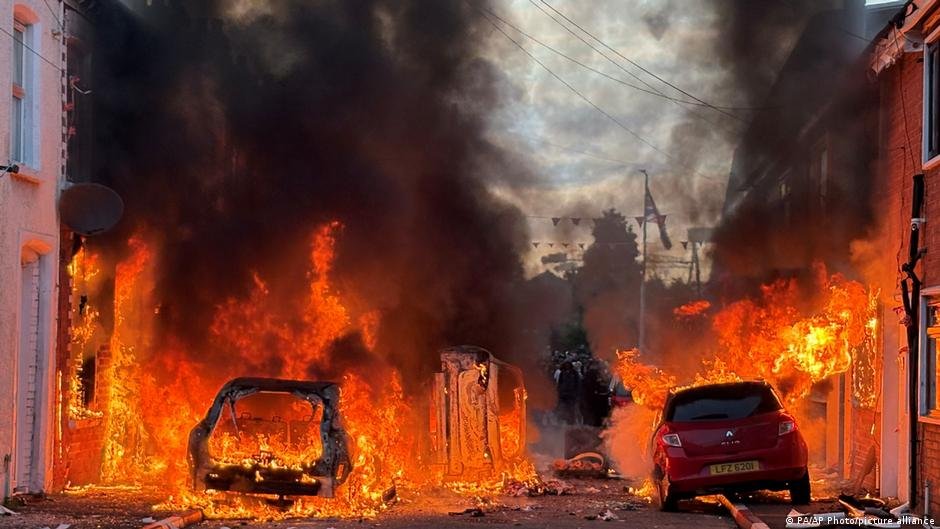
As anti-immigrant protests escalated, chaos descended on the Northern Irish capital Belfast on Monday and Tuesday evening. There was mob violence on the streets along with burning trashcans and thick plumes of smoke. The riots spread across entire neighborhoods, and a massive police deployment attempted to keep the riots under control.
Claire Hanna, the leader of the Leader of the Social Democratic and Labour Party in Northern Ireland, described the anti-immigrant violence as a “race-based pogrom” on the BBC’s Newsnight program.
“Children in my constituency, and in others, were lifted out of their beds as their homes burned,” she told the UK Parliament on Wednesday. “Masked men roamed the streets, going from door to door, menacing and setting fire to cars, buses and homes, terrorizing people on the basis of the color of their skin or the sound of their voice.”
On Wednesday, security forces prevented a repeat of the violence in Belfast. But marches and riots broke out in other cities across the United Kingdom. According to media reports, people were specifically targeted and attacked because of the color of their skin.
The unrest was ostensibly sparked by a video of a knife attack that went viral on social media. The video shows a man repeatedly stabbing another who is lying on the ground. The victim was taken to hospital, where he remains with serious wounds. The perpetrator was arrested at the scene and has been charged with attempted murder.
The 44-year-old victim is an Irish man. The 30-year-old suspect is a Sudanese man.
Racism stoked on social media platforms
First Minister of Northern Ireland Michelle O’Neill and British Prime Minister Keir Starmer condemned the violence and said that those responsible would be held to account. They also criticized people stoking racism and xenophobia on social media platforms.
The riots come at a time when various posts on platforms such as X and Telegram have helped to fuel an already tense and aggressive atmosphere. For example, Stephen Yaxley-Lennon, a far-right extremist who goes by the name of Tommy Robinson, and has been convicted multiple times, had called for mass protests across the UK. X CEO Elon Musk retweeted his post.
Other far-right extremists, particularly in the UK and the US, have called repeatedly for marches to protest against British immigration policy.
Reminiscent of summer 2024 riots
The violence in Belfast is reminiscent of the summer of 2024, when racist riots broke out across the UK after three girls died in a mass stabbing incident in the British coastal town of Southport.
Disinformation about the suspect was spread by far-right extremists, including Robinso, in order to systematically stoke racist violence online.
To view this video please enable JavaScript, and consider upgrading to a web browser that supports HTML5 video
Racism rife across United Kingdom
According to observers, the most violent riots this week took place in parts of Belfast which are home to largely Protestant working-class communities that are traditional unionist strongholds.
Though the 1998 Good Friday Agreement brought an end to decades of deadly civil conflict, known as the Troubles, a legacy of neglect is still felt across both unionist and nationalist communities. Unemployment is high and there is a lack of prospects in many parts of Northern Ireland. In addition, since Brexit, many Protestants in Northern Ireland have felt increasingly disconnected from the rest of the UK.
In 2024, the most violent riots broke out in the erstwhile industrial powerhouses of Sunderland, Middlesbrough and Hull in northern England, which have fallen into decline over the decades. High inflation rates, stagnant wages, and public services such as the NHS that have been crushed by austerity measures have intensified existential fears.
This week, the unrest has spread to Southampton in southern England, a city where 18 neighborhoods rank among the 10% of most deprived areas nationwide.
British politicians have fueled a hostile atmosphere
The anti-migration debate in Britain is not new. Successive Conservative governments tried to push through a controversial policy to send unwanted migrants to Rwanda for processing. Former Prime Minister Rishi Sunak pledged to “stop the boats,” refering to the small vessels used to traverse the English Channel from France, in 2023.
Far-right politicians such as Nigel Farage, the leader of the nationalist Reform UK party, have helped to normalize xenophobic narratives and anti-immigrant campaigns in British politics. He and Boris Johnson promised British voters that the UK would “take back control” of its borders if Brexit went ahead.
Immigration has remained high despite Brexit, and some voters believe that the state failed them.
Starmer has said there will be “no tolerance for abhorrent scenes of violence like this on our streets” and that rioters will face “the full force of the law.”
But it remains to be seen how quickly the violence will be quelled. In 2024, it took several days.
This article was originally published in German.