BMW makes five
BMW on Wednesday became the fifth German carmaker to announce major job cuts, as the country’s auto sector seeks to tackle rising competition from China.
The Munich-based firm said it would cut up to 8,000 jobs globally, representing about 5% of its 154,000-strong workforce.
BMW, which also owns the Mini and Rolls-Royce brands, said the job losses would primarily affect operations in Germany and be achieved through natural staff turnover and a voluntary redundancy program.
Although BMW was seen as more resilient to Chinese competition, the company warned last month that its sales in China were falling sharply.
Chinese rivals have intensified competition for electric vehicles (EV), which has crushed BMW’s sales volumes and pricing power.
Last year, BMW’s vehicle deliveries in China dropped to their lowest level since 2017 and in the three months to June, they fell 30% year-on-year.
US PresidentDonald Trump’s tariffs have also contributed to BMW’s woes, along with higher energy prices from the Iran war and the growth of Chinese EV-makers in other major markets, including Europe, Asia Pacific and Latin America.
On Thursday, the company disclosed that second-quarter net profit dropped 35% to €1.2 billion ($1.4 billion), while revenue fell to €31 billion from €34 billion.
BMW has adjusted its guidance for the rest of the year, warning of a “significant decline” in profit.
To view this video please enable JavaScript, and consider upgrading to a web browser that supports HTML5 video
Even Porsche isn’t immune
Two days earlier, Porsche announced plans to cut an additional 5,000 jobs in Germany by the end of 2035. The figure represents about 1 in 5 workers
The sports performance brand said the new measures would hit Porsche’s main production plant in Stuttgart-Zuffenhausen and its research and development (R&D) center in nearby Weissach.
Last year, Porsche announced a restructuring program to cut 1,900 jobs in the Stuttgart region by 2029 and allow 2,000 fixed-term contracts to expire.
The company will also defer wage increases, while performance bonuses will be more closely linked to profits.
Porsche, which is owned by Volkswagen Group but run with a high degree of independence, has also reduced jobs at its Leipzig plant and is closing three subsidiaries that employ about 500 people.
At the end of last year, Porsche employed nearly 41,800 people, with about 85% of them in Germany.
Volkswagen plans the deepest cuts
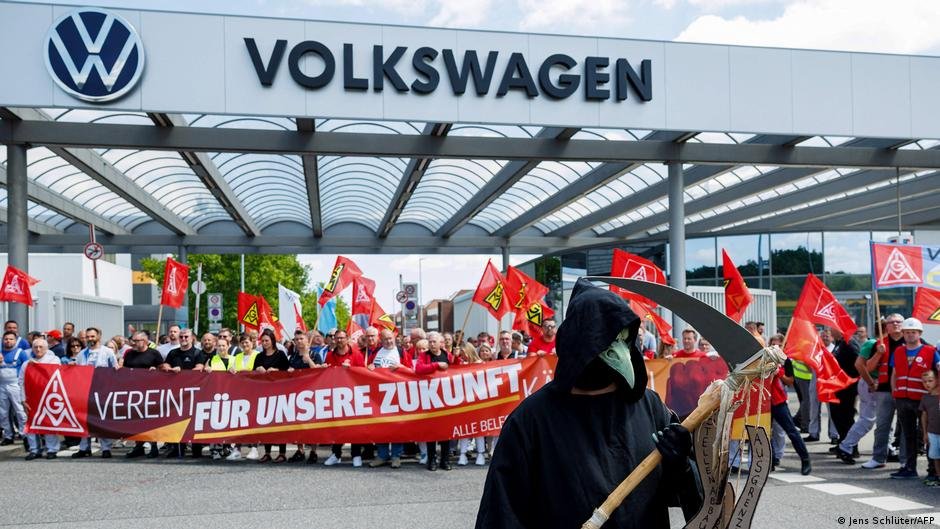
Volkswagen, Europe’s largest carmaker, last month doubled its job-cull program, announcing plans to slash up to 100,000 jobs.
The company also wants to close four German factories.
Unions and the German state of Lower Saxony, which holds a 20% voting stake and can veto major decisions, have rejected the latest plans. VW had originally stated it would cut 50,000 positions.
VW is well-known for its oversized headcount of 630,000 globally — 680,000 including Chinese joint ventures.
The Wolfsburg-based giant employs around 60% more workers than Toyota, despite producing a similar number of vehicles.
Once a sign of German industrial strength, the huge workforce has become a costly burden amid intensifying competition from Chinese EV-makers.
VW controls more stages of production in-house than rivals, driving up labor demand, while German factory costs are often twice those of rivals.
Slow progress on electric vehicles further eroded sales in China, which once accounted for a third of VW’s total, as well as Europe.
To view this video please enable JavaScript, and consider upgrading to a web browser that supports HTML5 video
Mercedes trims without mass firings
In March last year, Mercedes-Benz agreed with its works council plans to deliver €5 billion in savings by 2027.
However, the company ruled out compulsory redundancies at German plants, insisting that voluntary departures could achieve the reforms.
Until March this year, around 5,500 administration, R&D and IT workers accepted severance packages and left. Production workers remained protected.
Additional headcount reductions have been reported in the firm’s China operations.
Last month, Mercedes postponed a bonus payment for nearly three-quarters of its German workforce until 2027 and proposed extending the work week from 35 to 40 hours without extra pay.
Mercedes bosses also indicated that some jobs could be moved abroad.
On Tuesday (July 28), Mercedes said it had written off more than €700 million due to fierce competition in China.
Although second-quarter net profit grew 13.5% to €1.09 billion, core earnings at its key cars division fell by a quarter to €909 million.
Audi’s premium brand under pressure
VW-owned Audi last year announced plans to cut up to 7,500 jobs in Germany by the end of 2029.
The company has ruled out compulsory redundancies and said the job losses in administration and R&D would be achieved through voluntary schemes and early retirement.
Last month, however, Audi’s Neckarsulm plant was listed for possible closure in 2030 by parent company VW. This could impact about 15,000 workers.
The site, which makes the A5, A6 and A8, has already cut production from 300,000 to 225,000 vehicles a year.
Edited by: Rob Mudge
About The Author